
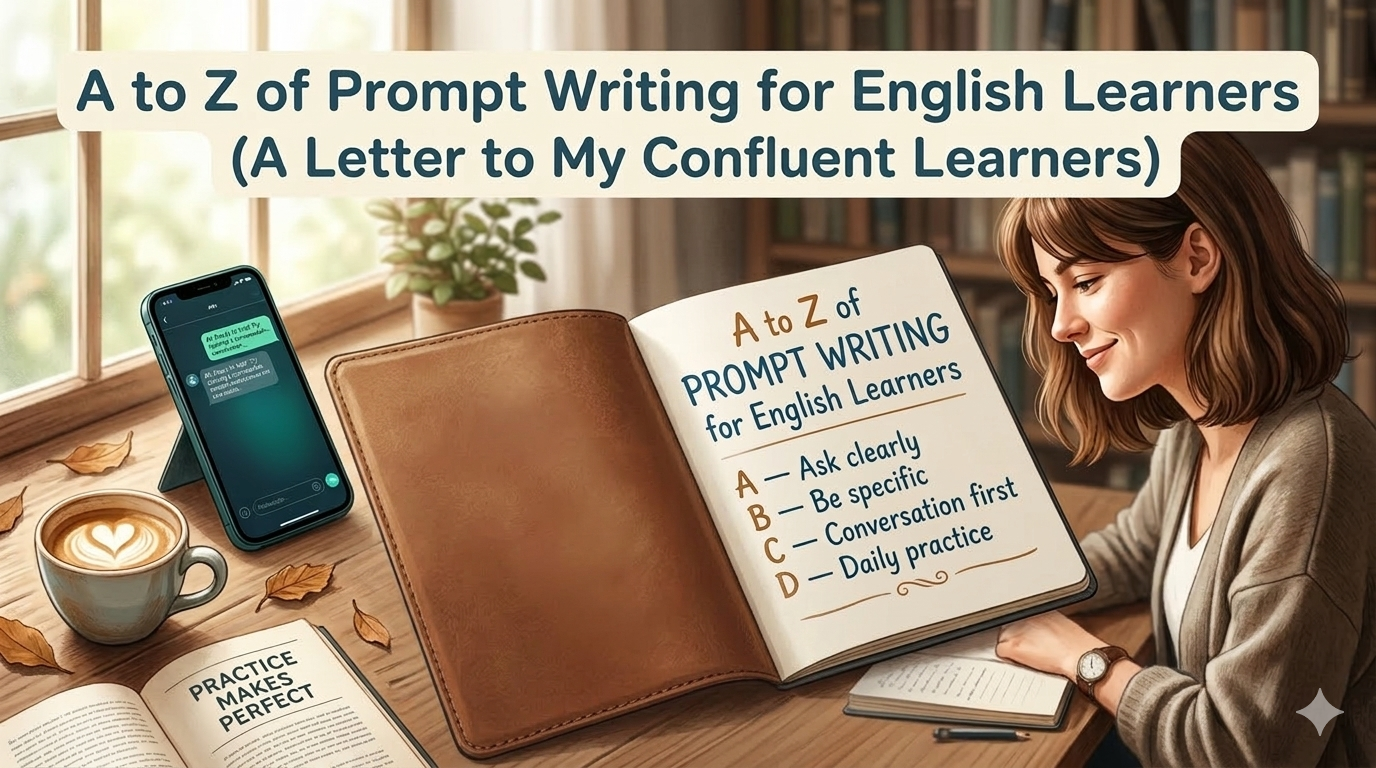
A to Z of Prompt Writing for English Learners
(A Letter to My Confluent Learners)
Dear learner,
A few years ago, if someone wanted to improve their English speaking, they needed teachers, classmates, or friends to practise with.
Today you have something different.
You have AI.
But here is the interesting thing: AI only becomes useful when you ask good questions.
In the AI world, those questions are called prompts.
A prompt is simply how you ask the AI to help you.
Many people open AI and type something like:
“Teach me English.”
That is like entering a gym and saying,
“Make me fit.”
The gym cannot guess what exercise you want.
AI is similar.
It becomes powerful when you learn how to talk to it clearly.
So let me share something simple with you — the A to Z of prompt writing for English learners.
Not as a technical guide.
Just as a friendly note from someone who wants you to practise more.
A — Ask clearly
Don’t say “help me with English.”
Say: “Help me practise English conversation for job interviews.”
Clarity makes AI useful.
B — Be specific
Instead of asking for “English tips,” ask:
“Give me 5 questions I might face in a job interview.”
C — Conversation first
English improves through conversation practice, not just explanations.
You can say:
“Let’s practise a conversation where you are the interviewer.”
D — Daily practice
Use AI for small daily practice.
Even 10 minutes of speaking practice can slowly improve fluency.
E — Explain simply
If something feels difficult, ask:
“Explain this in simple English.”
AI is very good at simplifying ideas.
F — Fix my sentence
One of the best prompts for learners:
“Correct my sentence and explain the mistake.”
Instant feedback is powerful.
G — Give examples
Examples help understanding.
You can ask:
“Give me 5 examples of this sentence structure.”
H — Help me think
English is not only language — it is thinking.
Ask AI to help you organise ideas before speaking.
I — Interview practice
Many learners want to improve English for jobs.
You can say:
“Conduct a mock interview with me.”
J — Just start speaking
Don’t overthink.
Just start a conversation.
AI will follow.
K — Keep it natural
Ask AI to respond like a real conversation partner.
For example:
“Reply like a friendly colleague.”
L — Learn by doing
Reading helps.
But speaking practice helps more.
Use AI actively.
M — Mistakes are welcome
Tell AI:
“Correct me when I make mistakes.”
This turns every conversation into learning.
N — New vocabulary in context
Instead of memorising words, ask:
“Teach me vocabulary related to business meetings.”
O — Opinion questions
Ask open-ended questions.
For example:
“Ask me 5 discussion questions about technology.”
P — Practise presentations
You can rehearse ideas before real meetings.
Try:
“Listen to my presentation and suggest improvements.”
Q — Questions create learning
The better your questions, the better the answers.
Prompting is really a communication skill.
R — Repeat explanations
If you don’t understand something, simply say:
“Explain it again with a different example.”
AI never gets irritated.
S — Speaking confidence
Ask AI to create situations where you practise speaking.
Confidence grows through repetition.
T — Think in English
You can even ask AI:
“Help me practise thinking in English instead of translating.”
U — Use real-life topics
Discuss news, work, travel, or hobbies.
Language becomes stronger when it connects to real life.
V — Vocabulary through stories
Stories make language memorable.
Try prompts like:
“Teach me 10 new words using a short story.”
W — Write and speak
You can write a paragraph and ask AI to improve it.
Then try speaking the improved version aloud.
X — eXperiment
There is no single perfect prompt.
Try different ways of asking.
Learning happens through experimentation.
Y — Your curiosity matters
AI works best when curiosity is strong.
Ask questions freely.
Z — Zero fear
The best thing about practising with AI is this:
There is zero judgment.
You can try again and again.
If you remember only one thing from this letter, let it be this:
AI is not just a tool for answers.
It can become your daily English practice partner.
But like every conversation in life, it begins with a simple step.
You ask.
And then the learning begins.
Good luck learner!