Why 12 Years of English Education Still Produce Silent Graduates
Let’s do simple maths.
5th standard to 12th standard.
Sometimes even from 1st standard.
Sometimes English medium from nursery.
That’s not 2 years.
Not 3 years.
That’s 8–12 years of English.
And yet…
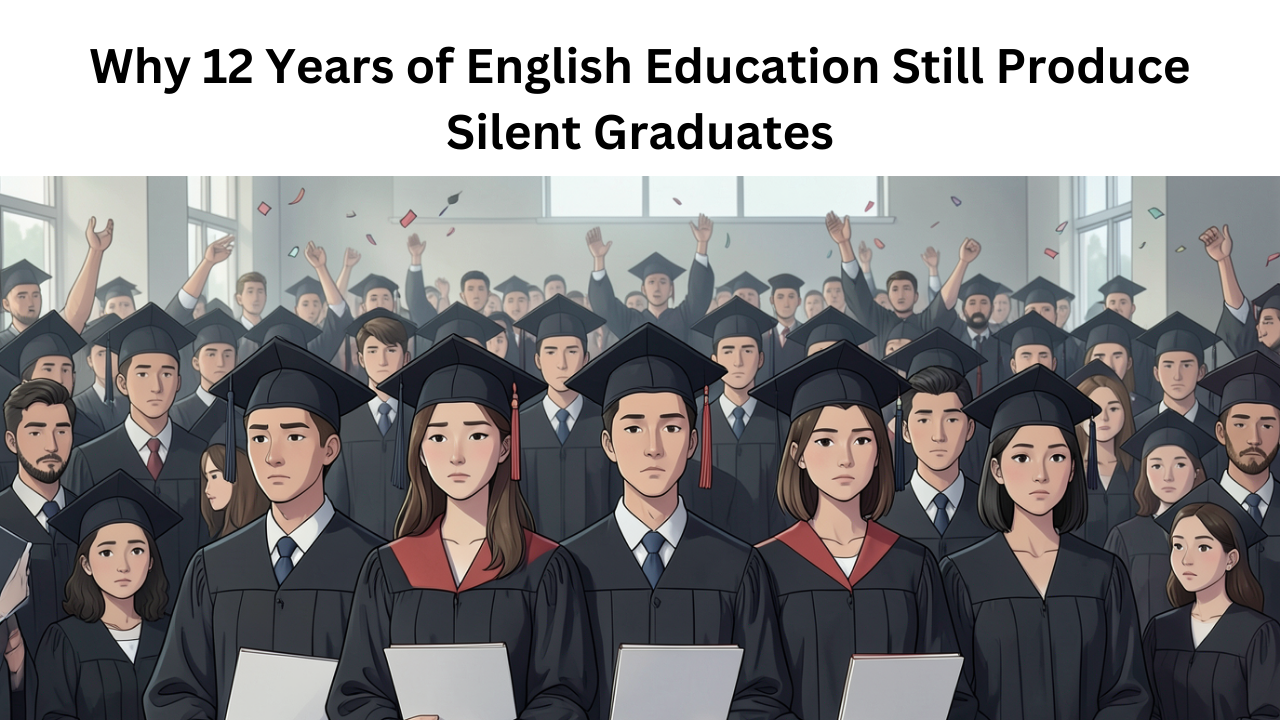
Graduation day comes.
Degree in hand.
CV ready.
But mouth?
Silent.
The Strange Indian Reality
In India, English is everywhere.
- On report cards
- On question papers
- On notice boards
- On LinkedIn
- In job descriptions
- In corporate emails
But not in our voice.
How is that possible?
How can someone study English for a decade…
and still hesitate to say:
“Good morning everyone, I would like to share my thoughts.”
Let’s Be Honest. It’s Not Intelligence.
It’s not that students are dumb.
It’s not that they didn’t study.
It’s not that they don’t know grammar.
In fact, many of them can:
- Identify tenses
- Write essays
- Fill blanks correctly
- Score 75%+ in board exams
But ask them in a meeting:
“Can you explain this idea?”
Suddenly:
- “Actually…”
- “Basically…”
- “Like…”
- Silence.
Real Indian Examples (You Know These People)
1. The Engineering Topper
He studied in a state board school.
English from 5th standard onwards.
He can solve thermodynamics.
He can code in Python.
He clears written tests.
But in campus placement GD?
He doesn’t speak.
Because he is translating in his head.
Because he is scared of making mistakes.
Because nobody trained him to speak — only to write.
2. The MBA Professional
She works in a corporate office in Mumbai.
She writes brilliant emails.
She understands everything in meetings.
But when it’s time to present?
Her heart races.
She says:
“I’m not confident in speaking English.”
After 15 years of studying English.
The issue isn’t knowledge.
It’s practice.
3. The Government School Student
English subject started in 5th standard.
Grammar-heavy.
Essay writing.
Letter writing.
But no:
- Daily speaking practice
- Roleplays
- Debate training
- Real conversation
So after 8 years of English…
He can write “My Favourite Festival is Diwali.”
But he cannot confidently explain his own dream.
4. The Corporate Manager
10 years in the industry.
Reads reports in English.
Writes proposals in English.
Sends emails daily.
But still thinks:
“My English is not good.”
Why?
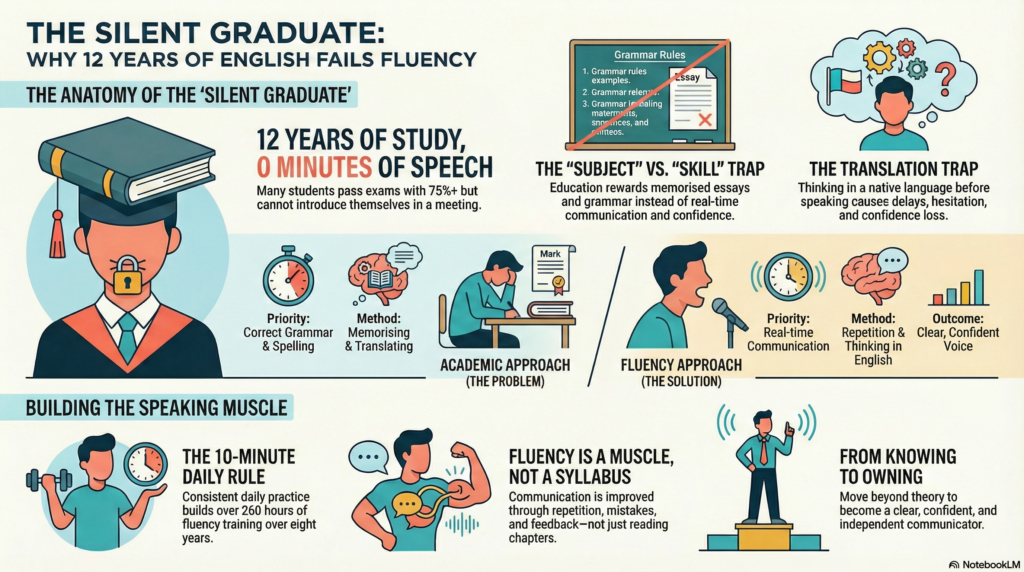
Because fluency is not about exposure.
It is about output.
The Real Problem: We Taught English as a Subject.
Not as a Skill.
Not as a Muscle.
We built a syllabus.
We didn’t build speakers.
We rewarded:
✔ Correct answers
✔ Neat handwriting
✔ Memorised essays
We ignored:
✖ Speaking confidence
✖ Thinking in English
✖ Real-time communication
The Translation Trap
Most Indian students don’t think in English.
They think in Hindi.
Or Gujarati.
Or Tamil.
Or Bengali.
Then translate.
Translation = delay.
Delay = hesitation.
Hesitation = loss of confidence.
After 12 years, they know English.
But they don’t own English.
Here’s the Brutal Truth
If you studied English for 10 years
and never spoke daily for 10 minutes,
you didn’t practise English.
You studied it.
And studying is not the same as speaking.
You cannot become fluent by:
- Reading chapters
- Underlining words
- Memorising essays
Fluency is built by:
- Repetition
- Conversation
- Mistakes
- Feedback
Like gym.
Like riyaaz.
Like driving.
Why Corporate People Still Relate
Many professionals reading this will quietly nod.
You completed:
- School
- College
- Maybe MBA
- Maybe engineering
But still avoid:
- Speaking in town halls
- Asking questions publicly
- Making videos
- Networking confidently
You are not undereducated.
You are under-practised.
The Missing 10 Minutes
Imagine this:
From 5th standard to graduation,
if every student spoke 10 minutes daily…
That’s:
10 minutes × 200 school days × 8 years
= 16,000 minutes of speaking.
That’s over 260 hours of speaking practice.
Now ask yourself honestly.
How many hours did you actually speak?
This Is Why Silent Graduates Exist
Not because India lacks intelligence.
But because India built a theory-heavy system.
We finished syllabus.
We passed exams.
We collected degrees.
But we didn’t train the voice.
And This Is Where Everything Changes
The future doesn’t need silent graduates.
It needs:
- Clear thinkers
- Confident speakers
- Independent communicators
The solution is not more grammar.
The solution is structured speaking practice.
Daily.
Simple.
Consistent.
Confidence is not gifted.
It is trained.
And once trained…
The silent graduate disappears.
The speaker emerges.
If you have studied English for years
but still hesitate to speak —
It’s not your fault.
But it is now your responsibility.
Speak.
Practise.
Repeat.
That’s how silence ends.