The Fear of Sounding Dumb
Today, I was having a long conversation with someone I have known for years.
She had attended my spoken English conversation club when I used to run group speaking practice sessions in my city. Back then, she was simply trying to become more confident in English. Today, she works with a large NGO, handles responsibilities, attends meetings, and speaks with people from different backgrounds.
At one point in our conversation, she said something that stayed with me.
“I want to say so many things in meetings, but I keep thinking… what if I sound dumb?”
I told her, “I’m going to write a blog about this.”
This is that blog.
And in many ways, it isn’t just for her.
It is for me too.
Because even while writing these words, a small voice in my head whispers the same question.
“What if this blog sounds dumb?”
Maybe someone will disagree.
Maybe someone will think this isn’t worth reading.
Maybe only one person will ever read it.
But then I remind myself of something much more important.
If one person reads this and feels understood, this blog has already done its job.
And if nobody reads it today, I still wanted to say it.
So I said it.
That is enough.
The fear of sounding dumb is rarely about language.
It is about judgment.
When someone says, “My English is weak,” they often don’t mean grammar.
They mean,
“I’m afraid people will think less of me.”
That fear appears everywhere.
A college student has an idea during a presentation but stays silent because everyone else seems more confident.
A young professional sits through a meeting, watches others speak, and tells themselves, “I’ll say something next time.”
Someone attends a networking event, rehearses an introduction in their head twenty times, and ends up smiling without speaking to anyone.
A manager types a message, deletes it, rewrites it, deletes it again, and finally sends the shortest possible version.
An entrepreneur records a video, watches it back, cringes at their own voice, and never uploads it.
The situations change.
The fear stays the same.
“What if I sound dumb?”
The strange thing is that we rarely ask the opposite question.
What if your idea helps someone?
What if your question starts an important discussion?
What if your presentation opens a new opportunity?
What if your video reaches exactly the person who needed to hear it?
We have trained our minds to predict embarrassment much faster than possibility.
Psychologists sometimes call this the spotlight effect.
We imagine everyone is watching us closely.
In reality, most people are thinking about themselves.
While you’re worrying about your sentence, the other person is worrying about theirs.
While you’re wondering whether your English sounds natural, they’re wondering if they made a good impression.
Everyone believes they are standing under a spotlight.
Most of the audience isn’t even looking.
This is something I have had to learn again and again.
Every blog I publish carries uncertainty.
Every workshop begins with uncertainty.
Every new idea feels unfinished before I share it.
Even this article.
There are probably better ways to express these thoughts.
Someone else could write this more beautifully.
Someone might find flaws in my reasoning.
But if I waited until every sentence felt perfect, I wouldn’t have written anything.
Perfection is often fear wearing professional clothes.
It sounds responsible.
It sounds thoughtful.
But many times, it is simply another excuse to stay invisible.
This is especially true when learning English.
Many learners delay or avoid speaking because they want perfect grammar first.
Ironically, proper grammar and fluency comes after speaking, not before it.
Children don’t wait until they know every rule before they start talking.
They talk.
They make mistakes.
People correct them.
They improve.
Adults often reverse the process.
They wait.
And wait.
And wait.
Then wonder why confidence never arrives.
Public speaking follows the same pattern.
Nobody gives a confident presentation before giving an uncomfortable one.
Nobody becomes a natural communicator without first sounding awkward.
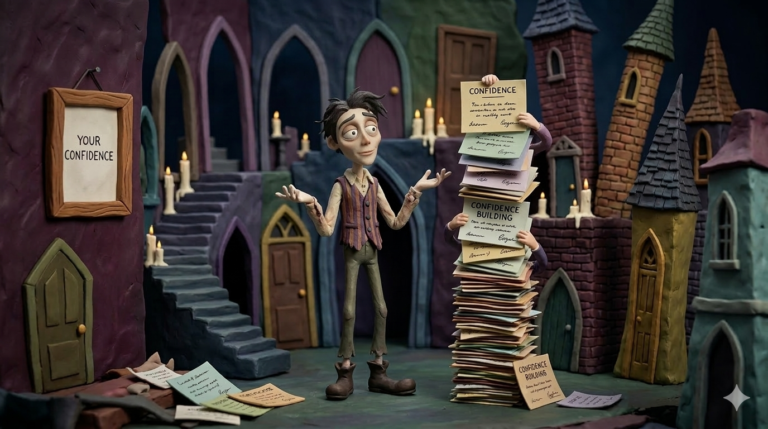
Confidence is not a prerequisite.
It is a consequence.
The same applies to writing.
People often ask me how I keep writing.
The answer is simple.
I don’t try to write perfect blogs.
I try to write honest ones.
Some articles will be forgotten.
Some videos will receive very few views.
Some ideas won’t work.
That is part of creating.
The internet has quietly taught us to measure every thought by its performance.
How many likes?
How many views?
How many comments?
But some of the most important things you will ever say cannot be measured by numbers.
Maybe one conversation changes a person’s confidence.
Maybe one sentence stays with someone for years.
Maybe one article helps a reader who never leaves a comment.
You may never know.
And that is okay.
If you constantly ask yourself, “What if I sound dumb?” your world becomes smaller.
You speak less.
You share less.
You create less.
You become less visible.
Eventually, it isn’t your English holding you back.
It is your fear.
My book talks about mindset because mindset comes before vocabulary.
Before grammar.
Before pronunciation.
Before fluency.
The conversation in your head shapes the conversation you have with the world.
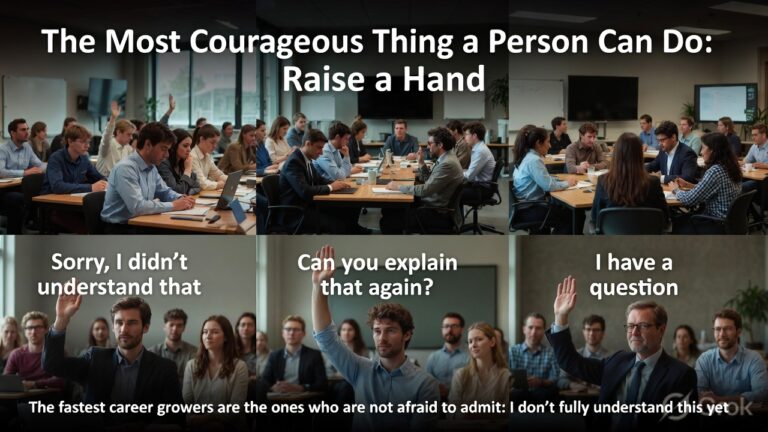
So the next time you hesitate to ask a question in class, contribute in a meeting, introduce yourself at an event, publish a post, or start a conversation in English, remember this.
The goal is not to avoid sounding dumb.
The goal is to contribute anyway.
Because every confident speaker you admire has sounded awkward before.
Every writer has published imperfect work.
Every leader has asked a question that felt foolish.
Every creator has wondered whether anyone would care.
The difference is not that they never had the fear.
The difference is that they didn’t let the fear make the decision.
So here’s a question I want to leave you with.
Instead of asking,
“What if I sound dumb?”
Try asking,
“What if staying silent costs me something far more valuable?”
Sometimes, the opportunity you are waiting for is waiting for the version of you that finally decides to speak.