How to Use AI to Assess Your Tenses
A good mechanic doesn’t open the bonnet first.
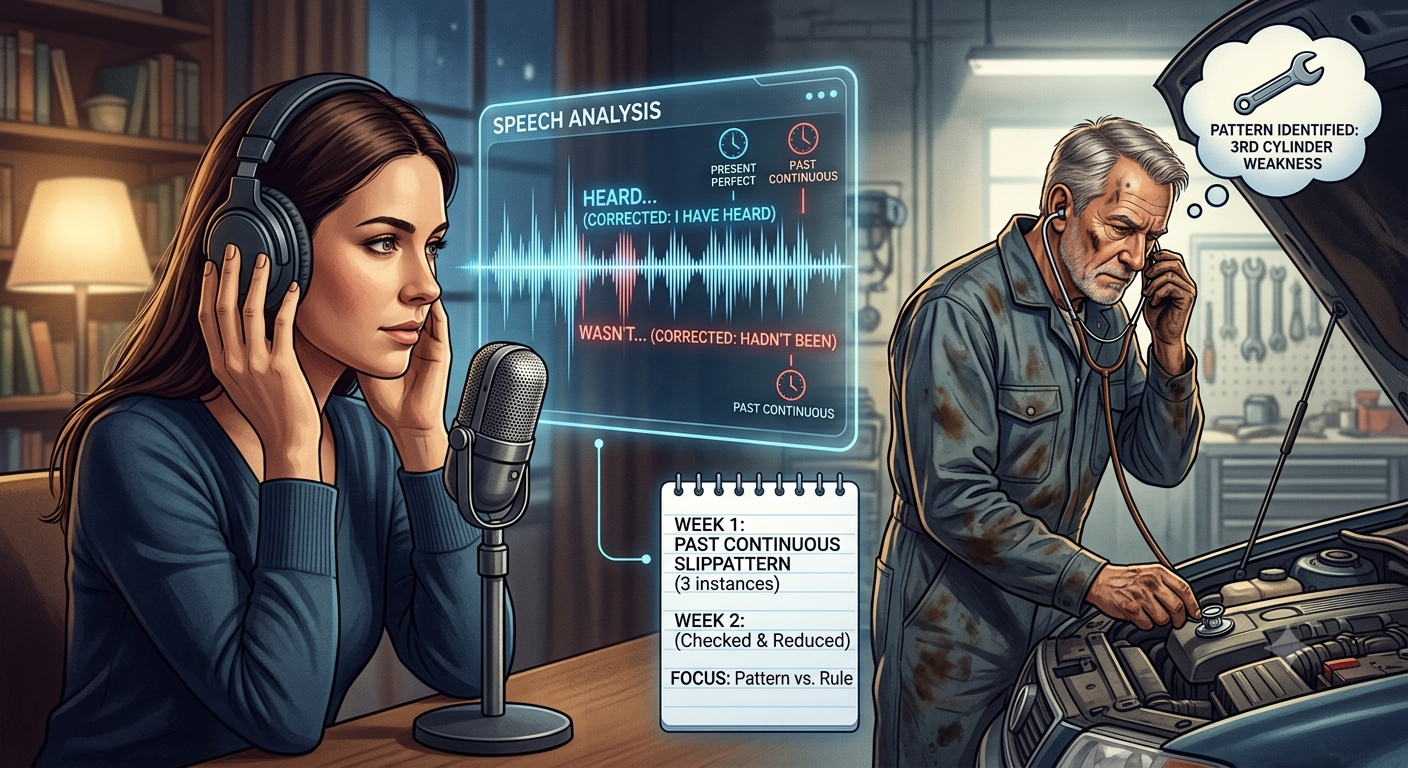
He listens. One minute, engine running, ear close, eyes half shut. Then he tells you exactly what’s wrong — not “there’s a problem,” but “it’s the third cylinder, and it’s been building for two weeks.” He didn’t guess. He’s heard that exact sound a thousand times before, on a thousand other engines, and he knows precisely what it means.
Most people who “have weak tenses” have never actually been listened to that way. They’ve been told, vaguely, “your tenses are off,” in a tone that sounds like a verdict, not a diagnosis. Nobody told them which tense, in which situation, slipping into what — the way a real mechanic would.
That specific listening is what AI feedback can actually do for you, if you ask it properly. Here’s how.
Step 1 — Get a real baseline, not a scripted one
Don’t test your tenses with a grammar exercise. That tests what you know, not what you actually do when you’re speaking freely — and those are two different things entirely.
Open AI voice mode and say:
“I’m going to talk for two minutes about my week, unscripted. Don’t interrupt me. At the end, tell me only about my tense usage — nothing else.”
Talk normally. Don’t think about tenses while you’re talking — that would defeat the entire purpose. You want the mistakes that show up when you’re not watching for them, because those are the ones that show up in real meetings too.
Step 2 — Ask for one tense at a time, not everything at once
This is the step almost everyone skips, and it’s the reason feedback usually goes nowhere. If AI gives you fifteen corrections across five different tenses in one go, you’ll remember maybe one of them, and forget it by tomorrow.
Instead, narrow it:
“Just look at my past tense usage in what I said. Where did I get it right, where did I slip, and show me the corrected version of each slip.”
Next session, do the same for present perfect. Then future continuous. One tense, fully diagnosed, before moving to the next — the same way the mechanic checks one system at a time, not the whole car in one glance.
Step 3 — Ask AI to find the pattern, not just the mistakes
A list of ten corrected sentences teaches you ten sentences. It doesn’t teach you the pattern behind them — and the pattern is the actual thing worth knowing, because that’s what’s repeating in every conversation you have, not just this one.
Ask directly:
“Looking at all my mistakes today, is there one pattern repeating? Am I making the same type of tense error in different sentences?”
Most Indian English speakers have one or two specific default patterns — often collapsing past continuous into simple past, or using present tense for completed actions because Hindi doesn’t mark tense the same way English does. Once AI names your specific pattern, you’re not fixing fifteen sentences anymore. You’re fixing one habit.
Step 4 — Ask why, not just what
This is the step that actually changes behavior, not just awareness of it. Once you know your pattern, ask:
“Why do I think I make this specific mistake? Is it something about how Hindi handles tense that’s carrying over into my English?”
The answer usually explains something you’ve felt but never had language for — why this particular slip feels so natural to you, and so invisible until someone points it out. That understanding is what makes the correction stick, rather than being one more rule you’re trying to remember under pressure.
Step 5 — Build a personal correction list, not a mental note
Don’t rely on remembering the pattern. Ask AI:
“Give me a short list — just three or four sentences — showing my mistake and the correct version side by side, that I can look at before my next practice session.”
Keep this list somewhere you’ll actually see it — notes app, WhatsApp message to yourself, whatever you’ll open again. The mechanic doesn’t re-diagnose the same engine every single time either. He remembers what he found last time and checks if it’s still there.
Step 6 — Retest the same pattern a week later
This is the step that turns feedback into an actual loop instead of a one-time correction. Seven days later, do the same two-minute unscripted talk again, on a different topic, and ask:
“Check specifically for the same tense pattern we found last week. Is it still showing up, or has it reduced?”
If it’s reduced — you now have proof the loop is working, not just a hope that it is. If it hasn’t moved, you’ve caught it early enough to adjust, rather than finding out six months later in an interview that mattered.
The point of all this
The mechanic who tells you “there’s a problem” isn’t wrong. He’s just useless. The one who tells you exactly which cylinder, and why, and whether it’s better than last month — that’s the one whose diagnosis you can actually act on.
Most tense feedback people get is the first kind — vague, discouraging, impossible to fix because it was never specific enough to fix. Used properly, AI gives you the second kind. Not “your tenses are weak.” One pattern, one reason, one week-over-week check — until eventually, you’re the one who hears the slip yourself, before anyone has to point it out at all.
MKPF tag: F — Feedback. Teaches a specific correction-and-diagnosis loop using AI — isolating one tense at a time, finding the repeating pattern, understanding its cause, and retesting weekly to confirm improvement.