How to Use AI to Practice a Fresher Job Interview Out Loud — Before the Real One Happens
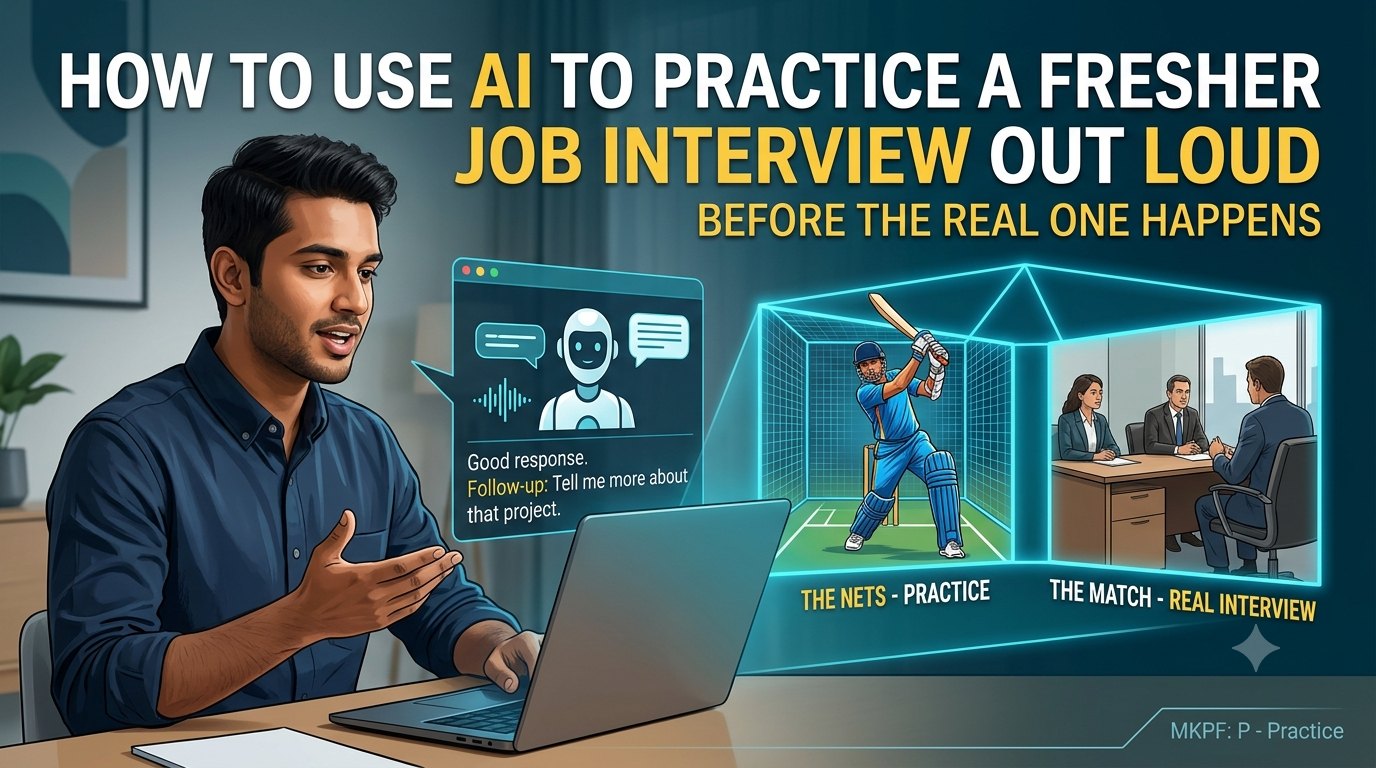
Sachin didn’t walk into a World Cup final without ever facing a ball first.
He faced thousands of them. In the nets. Alone, mostly. No crowd, no commentary, no scoreboard — just him, a bowler, and the exact same delivery he’d eventually face under real pressure, rehearsed until his body stopped thinking and just responded.
Most freshers walk into their first real interview having never once said their answers out loud. They’ve written them. Read them. Mentally rehearsed them in the shower. But said them, live, to another voice, under a little pressure — never.
That’s the gap. Not knowledge. Reps.
Here’s how to actually build the nets, using AI, before you walk out to bat for real.
Step 1 — Stop writing answers. Start saying them.
This is where almost every fresher goes wrong first. You open a Google Doc, write out “Tell me about yourself,” polish it for twenty minutes, read it back silently, feel ready.
You are not ready. You’ve rehearsed a written answer. Interviews are not written. The version of you that speaks under pressure has never once met this content.
So the first move is simple — close the document. Open an AI tool with voice mode — ChatGPT, Claude, Gemini, any of them — and say your answer out loud, to it, for the first time. Not perfect. Just out loud. That’s the actual starting line, not the polished paragraph.
Step 2 — Set the scene properly, don’t just “ask questions”
Don’t tell AI “ask me interview questions.” That gives you a quiz, not a rehearsal. Give it the actual scene:
“Act like an HR interviewer at a mid-size IT company, interviewing me for an entry-level analyst role. Ask me one question at a time, wait for my full answer, then respond naturally like a real interviewer would — including follow-up questions based on what I say.”
This one instruction changes everything. Now AI isn’t firing questions at you from a list — it’s reacting to your actual answer, the way a real person in the room would. That reaction is the part freshers have never practiced, and it’s the part that actually rattles people live.
Step 3 — Run the four questions that decide 80% of fresher interviews
Don’t try to cover everything in one session. Freshers lose most points on a small, predictable set of questions. Drill these specifically, out loud, more than once:
- “Tell me about yourself”
- “Why should we hire you, with no experience?”
- “What’s your biggest weakness?”
- “Where do you see yourself in five years?”
Say each one to AI, get its natural follow-up, answer that too. The follow-up is where freshers usually freeze in real interviews — because they rehearsed the opening line and nothing after it.
Step 4 — Ask AI to interrupt you like a real interviewer would
Real interviewers don’t let you finish your rehearsed paragraph uninterrupted. They jump in. They ask “can you give me an example of that?” halfway through. Tell AI to do the same:
“While I answer, feel free to interrupt with a follow-up question partway through, the way a real interviewer sometimes does — don’t wait for me to finish every time.”
This is uncomfortable the first time. That discomfort is the entire point — it’s exactly the discomfort the real room will produce, except here it costs you nothing.
Step 5 — Switch the tone halfway through the session
Fresher interviews aren’t always friendly. Some are warm, some are clipped, some panel members are deliberately testing how you handle pressure. Ask AI to shift:
“Now act like a slightly impatient, no-nonsense interviewer — short questions, less warmth, testing how I handle pressure.”
Running both versions back to back — friendly, then sharp — means neither version surprises you on the actual day.
Step 6 — Ask for the feedback that actually matters
At the end of the session, don’t just ask “how did I do.” Ask specifically:
“Which of my answers sounded rehearsed instead of natural? Which one would you have follow-up doubts about, if you were really hiring?”
This is the feedback freshers never get from practicing alone in front of a mirror — an honest read on where the answer sounded memorized versus where it sounded like a real person talking.
Step 7 — Do one full run, start to finish, no pausing
Once you’ve drilled the pieces, run the whole thing once, uninterrupted — greeting, the four core questions, a follow-up or two, a proper close. Fifteen minutes, no stopping to fix a sentence halfway through. This is the closest rehearsal to the actual day you’ll get before the actual day.
Step 8 — Take it into one real room within 48 hours
The AI session is the nets. It was never the match. Within two days, use this out loud in some real setting — a mock interview with a friend, a college placement cell session, even just narrating your answer to a family member. The nerves feel different in front of an actual person, even a friendly one — and that’s the exact gap this last step closes.
The point of all this
Sachin didn’t get good in the match. He got good in the nets, thousands of quiet repetitions before anyone was watching — so that by the time it mattered, his body had already done it a thousand times and the moment itself had nothing new to offer him.
Your interview isn’t won in the ten minutes you sit in that chair. It’s won in the fifteen-minute sessions nobody sees, in the days before — the same ball, faced enough times, until it stops feeling like a surprise.
MKPF tag: P — Practice. Teaches a specific, repeatable AI voice-mode setup and session structure for fresher interview rehearsal, closing with the mandatory real-room repetition.