How to Learn Active and Passive Voice grammar Using AI
There are two kinds of people who know active and passive voice.
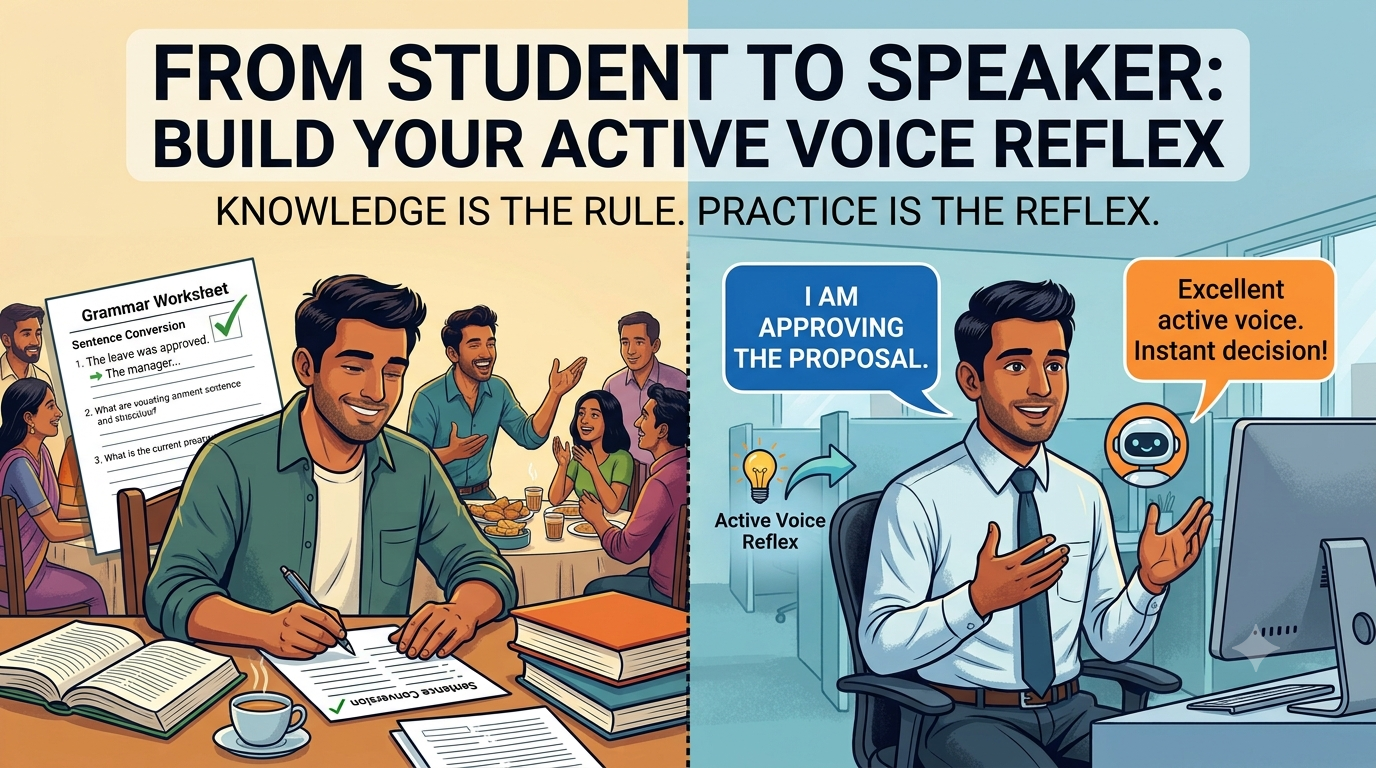
One kind can spot it in a worksheet. Underline the passive sentence, convert it to active, get the tick mark, move on.
The other kind can do that same conversion — mid-sentence, live, while actually talking to a person — without stopping to think about it at all.
Same rule. Same grammar. One of them is a student. The other is a speaker. Confluent is not building the first one. You already are the first one. We’re building the second.
Why this grammar rule quietly wrecks confidence in real conversations
Here’s the thing nobody tells you about active and passive voice — it’s not really a writing rule. It’s a power rule. It decides who’s doing the action and who’s receiving it, and in spoken English, that decision has to happen instantly, mid-breath, with no time to underline anything.
“The manager approved my leave” — active, direct, you sound sure of yourself. “My leave was approved by the manager” — passive, technically correct, but notice how much longer it takes to arrive at the actual point.
In writing, you have time. You can go back, restructure, polish. In speaking — in a meeting, in an interview, telling a story to a colleague — you don’t get that pause. If active-passive isn’t automatic, one of two things happens: you freeze mid-sentence trying to restructure it live, or you default to passive because it’s the “safer,” more textbook-sounding option — and end up sounding stiff exactly when you needed to sound confident.
This is a Knowledge gap first. Then it’s a Practice gap. Most courses stop at the first one.
Part One: Learn the Rule Properly — Using AI as Your Teacher
Don’t start by asking AI to “explain active and passive voice.” You’ll get a textbook definition you already half-know. Instead, get AI to build you a working model, tailored to how you actually mess it up.
Step 1 — Get AI to diagnose your specific gap first. Open ChatGPT, Claude, or Gemini and say: “I want to understand active and passive voice properly. Give me five sentences — a mix of active and passive — about everyday office situations, and ask me to identify which is which before you explain.”
This flips the usual method. Instead of being taught the rule and hoping it sticks, you test yourself first, and AI shows you exactly where your understanding breaks.
Step 2 — Ask for the conversion drill, not the definition. Say: “Now give me 10 passive sentences from real conversations — office, family, friends — and ask me to convert each to active. Correct me after each one, not at the end.”
Immediate correction beats a batch of corrections at the end — you’re building a reflex, not collecting a report card.
Step 3 — Ask AI to explain why people default to passive, specifically in your situations. This is the part almost nobody does, and it’s the difference between knowing the rule and owning it. Ask: “Why do Indian English speakers often use passive voice by default in professional settings? Give me real reasons, not textbook ones.”
You’ll usually get an honest answer — passive feels more formal, more “safe,” borrowed from how English was taught through translation from Hindi structures where the subject often gets buried. Once you know why you default to it, you stop doing it unconsciously.
Part Two: Practice It Like a Speaker, Not a Student
This is where almost every English course stops — and where Confluent actually starts. Knowing the rule changes nothing if it doesn’t survive contact with an actual conversation. So the practice has to happen out loud, live, under mild pressure — because that’s the only condition it’ll ever be needed in.
Step 1 — Turn on AI voice mode and build the scene, not the drill. Don’t ask AI to “test my active passive.” Say instead: “Act like my manager. Ask me to explain what happened in yesterday’s meeting. I’ll answer out loud — notice every time I slip into passive voice and gently point it out after I finish speaking, not while I’m talking.”
Now you’re not doing a grammar exercise. You’re rehearsing the exact moment this rule actually matters — explaining something to someone senior, live, under a little pressure.
Step 2 — Run it across three registers, back to back. Speakers need the rule to survive register changes, not just sentence types. In one AI voice session, run:
- A formal version — explaining a delay to a client
- A casual version — telling a friend the same story
- A narrative version — recounting it like a story to a group
Same content, three deliveries. Notice how passive creeps in specifically in the formal one — that’s the exact moment real meetings put you under.
Step 3 — Ask AI to replay your own sentence back to you, both ways. After a session, say: “Take my three passive sentences from today and say them back to me — first passive, then active — so I can hear the difference, not just read it.”
Hearing the two versions back to back, in your own words, does something reading a rule never does — it teaches your ear, not just your eye.
Step 4 — Take it into a real room within 48 hours. This is the non-negotiable last step. The AI rehearsal room is not the destination — it’s the runway. Within two days of the session, use active voice deliberately in one real conversation — a meeting, a call, a college session, anywhere. Not perfectly. Just once, on purpose, noticing yourself do it.
That single real-world repetition is worth more than another twenty AI drills. The rule isn’t learned until it’s survived a room with actual stakes in it.
The point of all of this
Active and passive voice was never really about grammar. It’s about who sounds like they’re in control of the sentence — and by extension, the room.
You already knew the rule. What you didn’t have was a place to make it automatic, and a reason to take it further than the worksheet. That’s the whole difference between a learner and a speaker.
The rule doesn’t live in the exercise. It lives in the next real conversation you have.
MKPF tag: K + P — Knowledge (understanding the mechanic and why it breaks under speaking pressure) into Practice (scene-based AI voice drilling, register-switching, and the mandatory real-room repetition). Kept as one piece deliberately, since the audience is speakers, not just learners — the knowledge is incomplete without the practice that follows it.