
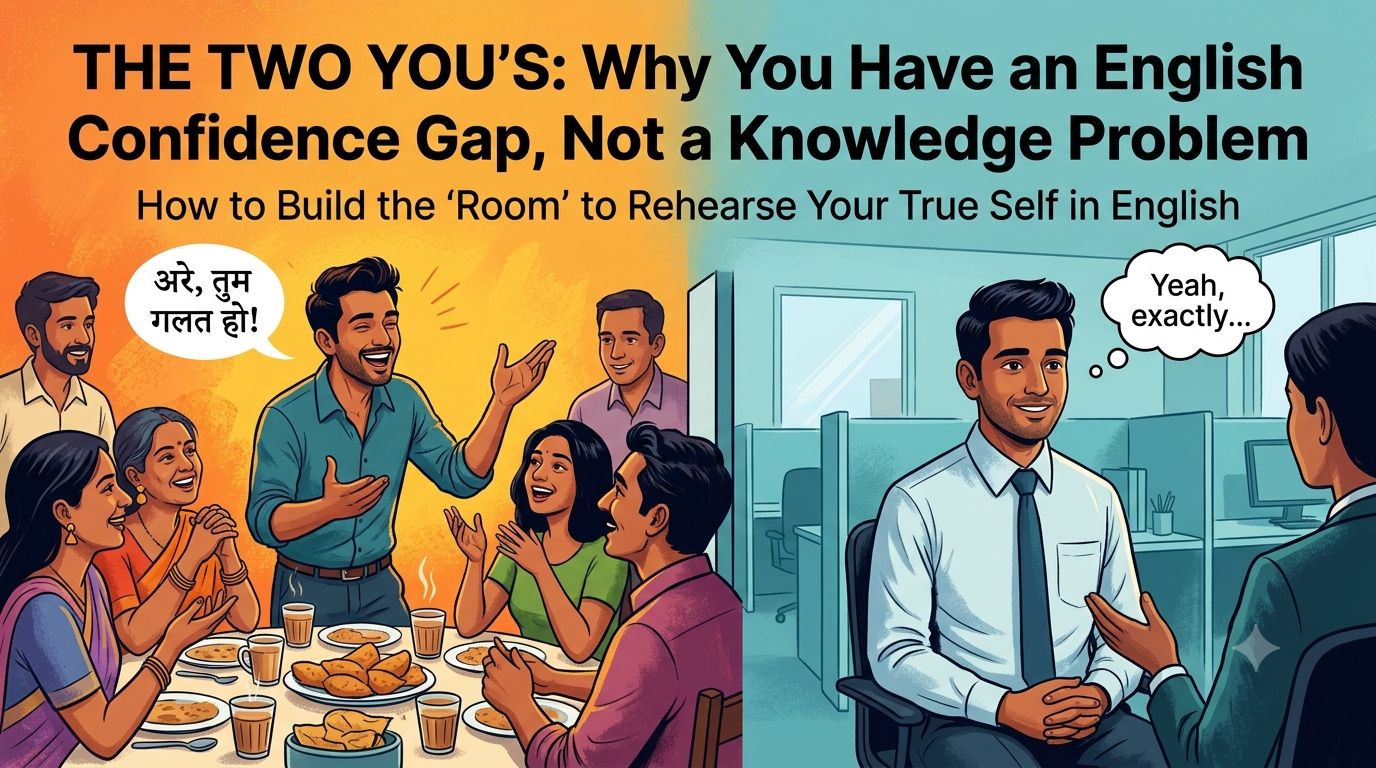
The 2 yous.. the English you and the Hindi you.
You have two versions of yourself.
One version — in Hindi (or your mother tongue), with your friends, with your family — that guy argues, jokes, convinces people, wins arguments he has no business winning.
Other version — in English, in office, in interview — same guy… just nodding. Smiling. Saying “yeah, exactly” to things he doesn’t even agree with.
Same brain. Same person. So what changed?
Nothing changed in your English. What changed is — nobody ever gave that first guy a room to practice in English.
That’s the actual gap. Not knowledge. Room.
The two you’s aren’t actually two people
Here’s what’s easy to miss when you’re living inside this — you don’t have an English problem and a Hindi confidence. You have one personality, and it only got a stage in one language.
Think about it properly. The Hindi version of you didn’t get confident by studying confidence. He got confident by talking — badly, loudly, wrongly, for years, in rooms where nobody was grading him. Dinner table. Group chat. Argument with your cousin about who’s the better captain, Dhoni or Kohli. Thousands of hours of unfiltered, ungraded talking.
The English version never got those hours. He got grammar classes. He got “correct this sentence.” He got tested on English, never let loose in it. So of course he’s quieter. He was never in the room long enough to become the other guy.
This is the part most people get wrong about “improving their English” — they think the fix is more input. More words, more grammar, more watching English shows. But your second self doesn’t need more input. He needs what the first self already got for free: an ungraded room, and enough hours in it.
Why this room never existed before
For years, there was genuinely no place to get this. A classroom has thirty other people watching you fumble. An office meeting has your boss watching. Even your friends — if you switch to English mid-conversation to “practice,” it feels performative, and somebody will laugh, and that’s it, you’re back in your shell for another six months.
The room your Hindi-self got by accident — private, repeated, judgment-free — simply didn’t exist in English. Until now it does, and most people haven’t clocked what that actually means for them.
How to actually build that room, using AI
This is the part that matters, so don’t skim it.
Step 1 — Stop treating AI as a grammar checker. That’s the mistake almost everyone makes first. Open any AI tool with voice mode — ChatGPT, Claude, Gemini, doesn’t matter which — and instead of asking it to “check my English,” tell it to become a room. Literally say: “Act like my colleague. We’re having a normal conversation about our weekend. Don’t correct me, just talk back naturally.” That one instruction changes everything — you’ve just built the ungraded room your first self had for free.
Step 2 — Pick the exact scene where your second self goes quiet. Not “practice English” in general — too vague, you’ll give up in three days. Pick the interview. Pick the client call. Pick the exact meeting where you nod instead of speak. Tell the AI that scene, specifically: “You’re my interviewer for a marketing role, ask me real questions.” Now you’re rehearsing the actual room, not a random one.
Step 3 — Talk badly on purpose, for the first few sessions. This is the one people skip and then wonder why nothing’s changing. Your Hindi-self didn’t get fluent by getting every sentence right first. He got fluent by saying the wrong thing a thousand times in a row, with nobody keeping count. Give your English self the same permission. Ten minutes, out loud, mistakes allowed, nobody grading.
Step 4 — Do it before the real room, not instead of it. The point was never to live inside AI conversations forever. It’s a rehearsal room, not a replacement stage. Use it the morning of the real interview, the night before the real presentation — the same way an actor runs lines before walking on stage, not as a substitute for the stage itself.
The actual point
Nothing was ever wrong with your English. What was missing was hours — ungraded, repeated, pressure-free hours — in a room built for that language, the same kind of room your other self has been living rent-free in since childhood.
You’re not learning English. You’re finally giving your second self the room your first self always had.



Indeed a self-reflective post. Specially for those who do not get English speaking surroundings at home right from the beginning. It’s a common concern which generally goes unreported. Thanks for sharing Sir!
Well explained
Eloborately explained each point.
Nicely explained! It’s fun reading this 👍