The Vocabulary Kitchen – The Complete Guide to What Vocabulary Actually Is
The most important thing nobody taught you about vocabulary learning — and how AI can teach it to you now.
Let me start with a question.
If someone asked you to improve your vocabulary right now — what would you do?
Most people would open a dictionary. Or download a word-of-the-day app. Or start reading a newspaper. Or buy a book with titles like 3000 Advanced English Words or Vocabulary for Competitive Exams.
All of those things have value. None of them are wrong.
But all of them are teaching you one thing — individual words. Difficult, impressive, advanced individual words.
And individual words are maybe ten percent of what vocabulary actually is.
The other ninety percent — nobody taught you. Not in school. Not in tuition. Not in any English class you ever sat in.
This blog is the other ninety percent.
Why We Were Taught Only One Thing
The education system taught vocabulary for one purpose — examinations.
Examinations test words. Synonyms. Antonyms. Fill in the blank. Reading comprehension with difficult words underlined. The entire vocabulary curriculum was built around that test format.
So teachers taught words. Students memorised words. Examinations tested words. Everyone moved on.
Nobody stopped to ask — but what about the other tools? What about the parts of language that make communication alive, colourful, funny, moving, memorable? What about the tools that writers use, that great speakers use, that comedians use, that politicians use, that your favourite film dialogue uses?
Those tools have names. They have been studied and used for thousands of years — by philosophers, linguists, literature lovers, poets, orators. They exist in textbooks. They exist in academic papers. They are real, documented, powerful tools of language.
But they stayed inside universities. Inside literature classrooms. Inside the world of people who chose to study language professionally.
The general public never got them. Not because they are too difficult. Because nobody thought to teach them in simple, practical, usable form.
That changes today.
The Full Kitchen — Every Tool Your Vocabulary Needs
Think of language as a kitchen.
A good cook does not use only one ingredient. Salt alone makes food unpleasant. Sugar alone is sickening. Oil alone is worse. But salt and sugar and spice and sourness and sweetness together — in the right combinations, in the right moments — create something that makes people close their eyes when they taste it.
Your vocabulary is the same.
You need different tools for different jobs. Some tools inform. Some tools create pictures. Some tools make people laugh. Some tools carry emotion so precisely that the listener feels exactly what you felt. Some tools make a point so sharp it stays in the mind for days.
Here is every tool in the kitchen. With examples. With AI prompts. With the specific job each one does that no other tool can do.
Tool 1 — Individual Words
Job: Precision. Saying exactly what you mean.
Yes, individual words matter. Resilient is more precise than strong. Melancholy is more precise than sad. Spontaneous is more precise than not planned.
The right word in the right place does something no other word can do. It closes the gap between what you mean and what the listener understands.
But words alone — even hundreds of advanced words — do not make language rich. They make it accurate. Accurate is good. Rich is better. Rich requires the rest of the kitchen.
With AI: “I used the word ‘difficult’ in this sentence. Give me five more precise words that each mean a different kind of difficult — and show me when to use each one.”
Tool 2 — Phrases
Job: Naturalness. Sounding like a person, not a textbook.
Some words always travel together. They are a unit. You cannot separate them without breaking the meaning.
Under the weather — feeling sick. On the same page — understanding each other. In the long run — over a long period of time. Get the ball rolling — start something. Once in a blue moon — very rarely.
These are phrases. And here is why they matter — native English speakers use them constantly, automatically, without thinking. When you use them correctly, something clicks in the listener. Something sounds natural. Something sounds like a real person speaking rather than someone translating from another language in their head.
Most learners never study phrases as a separate category. They learn words. They miss the groups those words travel in. And their English sounds correct but slightly wooden — like a photograph of a room rather than the room itself.
With AI: “Have a conversation with me about my week. After I speak, tell me two phrases I could have used naturally that would have made my English sound more fluent.”
Tool 3 — Phrasal Verbs
Job: Everyday fluency. The vocabulary of real spoken English.
A phrasal verb is a verb combined with a preposition or adverb that creates a completely new meaning.
Give up — to stop trying. Not to give something upward. Run into — to meet someone unexpectedly. Not to physically run into them. Figure out — to understand or solve something. Not to draw a figure outward. Look after — to take care of someone. Not to look in the direction of after. Bring up — to mention a topic. Not to carry something upward.
Phrasal verbs are everywhere in spoken English. In conversations, films, series, podcasts — phrasal verbs appear constantly. They are the vocabulary of real everyday English. Not formal English. Not examination English. The English people actually speak.
Most grammar books teach them as a list to memorise. That does not work. Phrasal verbs are learned through use — hearing them in context, using them in conversation, having someone confirm when you used them correctly.
AI is perfect for this.
With AI: “Teach me five phrasal verbs I can use in daily office or college conversations. Give me the meaning, one example sentence, and then ask me to make my own sentence with each one.”
Tool 4 — Idioms
Job: Colour. The spice that makes language memorable.
An idiom is a group of words whose meaning is completely different from the literal meaning of those words.
It is raining cats and dogs. No cats. No dogs. Just heavy rain. Bite the bullet. No bullet. No biting. Just doing something difficult without complaining. Spill the beans. No beans. No spilling. Just revealing a secret. Hit the nail on the head. No nail. No hammer. Just saying exactly the right thing. Burn the midnight oil. No oil. No burning. Just working very late.
Every language has idioms. Hindi has them. Marathi has them. Your mother tongue has dozens you use every day without knowing they are idioms — naak mein dum, haath tight hai, aankh ka taara. You never studied these. You absorbed them. From family. From community. From being inside the language.
English idioms are the same — learnable, usable, and once you know them, impossible to unhear. You will start noticing them everywhere. In films you have watched ten times. In conversations you had years ago. They were always there. You just did not have the name for them.
With AI: “Give me five English idioms I can use in everyday conversation. Tell me the meaning of each, the story behind it if there is one, and give me a situation where I would naturally use it. Then quiz me.”
Tool 5 — Metaphors
Job: Pictures. Making ideas land instead of just being heard.
A metaphor is when you describe one thing by calling it something else entirely.
Life is a journey. Life is not literally a journey. But the moment you say it that way — something lands. The listener does not just understand. They see.
Time is money. Time is not literally money. But something about that comparison captures a truth that three paragraphs of explanation never quite reaches.
His words were a knife. Words are not knives. But you felt the sharpness. You felt the cut.
Metaphors do not just describe. They create experience. They transfer a feeling from inside you to inside the listener — directly, without explanation, without effort.
The best speakers in the world — politicians, teachers, storytellers, TED talk givers, stand-up comedians — use metaphors constantly. Not because they are showing off. Because a good metaphor does in five words what five sentences cannot.
And here is the thing about metaphors — you already use them in your mother tongue every single day. When you say something in Hindi that creates a picture rather than just carrying information — that is a metaphor. The instinct is already there. AI helps you build the same instinct in English.
With AI: “I want to describe my college life using a metaphor. Help me find one that feels true. Ask me questions about my college experience and then suggest two or three metaphors based on what I tell you.”
Tool 6 — Similes
Job: Comparison. Making the unfamiliar feel familiar.
A simile is like a metaphor but uses like or as to make the comparison explicit.
Her voice was like honey. Not literally honey. But warm, smooth, slow, pleasant. He was as nervous as a student before results. You felt it immediately. No explanation needed. The city at night was like a circuit board — millions of small lights connected by invisible lines.
Similes are slightly gentler than metaphors. They say — this thing is like that thing — rather than — this thing is that thing. That small difference makes similes feel more conversational, more accessible, more like the way people naturally talk.
With AI: “I want to describe how I felt before an important moment in my life — an exam, an interview, a performance. Help me describe it using a simile. Ask me what the moment felt like and suggest three similes based on my answer.”
Tool 7 — Irony
Job: Intelligence. Saying the opposite of what you mean — and trusting the listener to understand.
Irony is when you say one thing and mean another — usually the opposite.
It is pouring rain. Someone says: “Lovely weather today.” Nobody thinks they actually mean lovely. The irony is understood immediately. And something happens in that moment — a small connection, a shared understanding, a tiny flash of intelligence between speaker and listener.
“Oh great, another Monday.” Not great. Not at all great. But the irony carries the feeling more precisely than “I do not enjoy Mondays” ever could.
Irony is everywhere in English humour. In British comedy. In American sitcoms. In the dry wit of people who are very comfortable with language. When you understand irony — and can use it — you are no longer just speaking English. You are playing with it.
With AI: “Explain irony to me with five examples from everyday Indian life — situations where someone would use irony naturally. Then help me practice using it in a short conversation.”
Tool 8 — Puns and Wordplay
Job: Play. Showing you own the language, not just use it.
A pun uses a word that has two meanings — or two words that sound similar — to create a double meaning.
I used to be a banker but I lost interest. Lost interest — in the job, and in earning bank interest. Both meanings. Simultaneously.
Time flies like an arrow. Fruit flies like a banana. Read it slowly. The second sentence completely rewrites the first — using the same words differently.
Puns feel like jokes. But they are actually demonstrations of deep language understanding. To make a pun you need to know a word well enough to see both its meanings at the same time. You need to hold two ideas simultaneously and find the place where they overlap.
Most learners think puns are too advanced. They are not. They are too playful for people who are still afraid of English. The moment you stop being afraid — puns become one of the most enjoyable parts of learning.
With AI: “Teach me three simple English puns. Explain why each one works — what the two meanings are. Then try to help me make my own simple pun about something from my daily life.”
Tool 9 — Quotes and References
Job: Depth. Carrying other voices and wisdom into your own sentences.
A well-placed quote does something specific. It says — this idea is not just mine. Someone wiser, older, more experienced also believed this. It adds authority without arrogance. Weight without heaviness.
As they say — actions speak louder than words. There is a reason people say — the first impression is the last impression.Einstein once said that imagination is more important than knowledge. I think about that every time I sit with AI.
Quotes also create connection — especially in Indian English, where film dialogue, cricket commentary, political speeches, and literature references are a shared cultural vocabulary. The right reference opens a door between speaker and listener instantly.
With AI: “Give me five famous English quotes that relate to learning, growth, or communication. For each one explain what it means in simple words and give me one situation where I could use it naturally in conversation.”
The Same Sentence. Seven Different Kitchens.
Let me show you what all of this looks like in practice. One idea. Expressed seven different ways using seven different tools.
The idea: I was very nervous before my job interview.
Just words: I was extremely anxious before my job interview.
With a phrase: I was a bundle of nerves before my job interview.
With an idiom: Before the interview my heart was in my mouth the entire morning.
With a metaphor: The interview was a mountain I had been staring at for weeks — and suddenly I was at the base of it.
With a simile: I was as nervous as a student who forgot to study — standing outside the exam hall.
With irony: Oh I was perfectly calm. Totally fine. Only checked my phone forty seven times.
With a quote: Someone once said that courage is not the absence of fear — it is acting despite it. That morning I finally understood what that meant.
Same feeling. Seven completely different experiences of it. Seven different effects on the listener. Seven different tools from the kitchen.
None of them wrong. Each one doing something the others cannot.
How AI Gives You Feedback on All of This
Now here is where it gets practical.
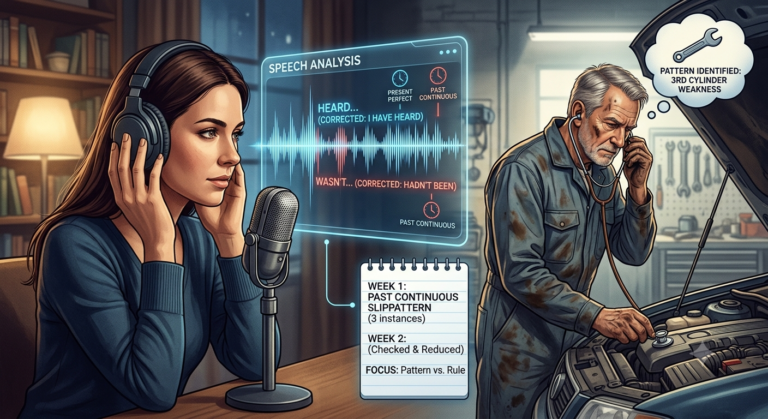
AI can give you feedback not just on your words — but on your whole kitchen. On what is there and what is missing. On which tools you are using and which ones you have never picked up.
Here is how.
Check 1 — Do you use any idioms?
Have a conversation with AI. Talk about your day, your work, your opinions. Speak or type naturally for two to three minutes.
Then ask:
“Did I use any idioms or idiomatic expressions in what I just said? If not, suggest two idioms that would have fit naturally somewhere in my sentences.”
If AI says you used none — that is feedback. Your kitchen has no spices yet. That is not a criticism. It is a diagnosis. Now you know what to add.
Check 2 — Do you use any phrases?
After a conversation, ask:
“Did I use any natural English phrases — groups of words that go together — or did I mostly use single words? Give me two phrases that would have made my sentences sound more natural.”
This shows you whether your English sounds like a person or a dictionary. Phrases are what make the difference.
Check 3 — Can you use a metaphor?
Pick any topic. Your college life. Your city. Your job. Describe it in two sentences to AI.
Then ask:
“Can you help me describe the same thing using a metaphor? Show me one example. Then ask me to try making my own metaphor for the same topic.”
Now try. AI tells you if your metaphor worked. If it felt forced or if it landed.
This is not a test. It is practice at a level most English learners never reach — because nobody told them this level existed.
Check 4 — Is there any fun in your English?
This one is the most honest check.
After a conversation, ask AI:
“Was there any wordplay, humour, or lightness in the way I spoke? Or was my English only functional — only carrying information, never playing with it?”
Read the answer carefully.
Functional English gets the job done. But playful English creates connection. Makes people remember you. Makes conversations enjoyable rather than just useful.
If AI tells you your English is only functional — that is not a failure. Most learners are only functional. The system trained them to be. But now you know. And knowing is the beginning of changing.
Is this for you?
This is not just for students. This is for anyone who uses English to communicate.
The lawyer who wants to argue more persuasively — metaphors and irony. The professional who wants to sound more natural in meetings — phrases and phrasal verbs. The student who wants to write answers that stand out — idioms and quotes. The person who wants to make people laugh in English — puns and wordplay. The speaker who wants to make people feel something — metaphors and similes.
The question is not whether these tools are for you. The question is which ones you have been missing — and how quickly AI can help you find them.
The gap is not knowledge. The gap is vocabulary tools.
Most of those people were never shown the full kitchen. They were shown one shelf — difficult words — and told that was vocabulary. They spent years collecting words from that shelf and wondered why their English still felt incomplete.
This blog exists to show the rest of the kitchen.
Not as an academic exercise. Not as a literature lesson. As a practical, usable, AI-assisted guide to the tools that make language alive.
You already have the English. Now you have the tools.
Go cook something.