The Day We Learned to Use Fire
A blog for the person who has heard about AI, scrolled past it, and is not sure if it is worth their time.
Nobody discovered fire.
Fire was always there. In lightning. In volcanoes. In the dry forest after a summer afternoon. Early humans did not find something new. They found a relationship with something ancient. Something that had been burning long before them and would keep burning long after.
What changed was not fire. What changed was the human who stopped running from it.
The moment someone — nobody knows their name, nobody wrote it down, this was four hundred thousand years ago — the moment someone stopped running and stayed. Watched. Moved closer. Reached out. That moment did not just give humans warmth. That moment rewired everything.
Cooked food changed digestion. Changed digestion changed the size of the human brain over thousands of generations. Changed brains changed language. Changed language changed thought. Changed thought changed civilisation. Changed civilisation changed you — sitting here, reading this, in a world built entirely on the chain reaction of one person who decided to stop running from something that scared them.
One decision. Four hundred thousand years of consequences. None of them planned. All of them real.
I think about that person when I think about AI.
What Fire Actually Did — The Invisible Chain
We talk about fire as warmth and cooking. Those are the visible things. The things you can point to and explain in one sentence.
But fire did something else. Something nobody planned.
Fire extended the day.
Before fire, when the sun went down, humans stopped. There was nothing to do in darkness except sleep and survive until morning. The day was the boundary of human activity. The night was lost time.
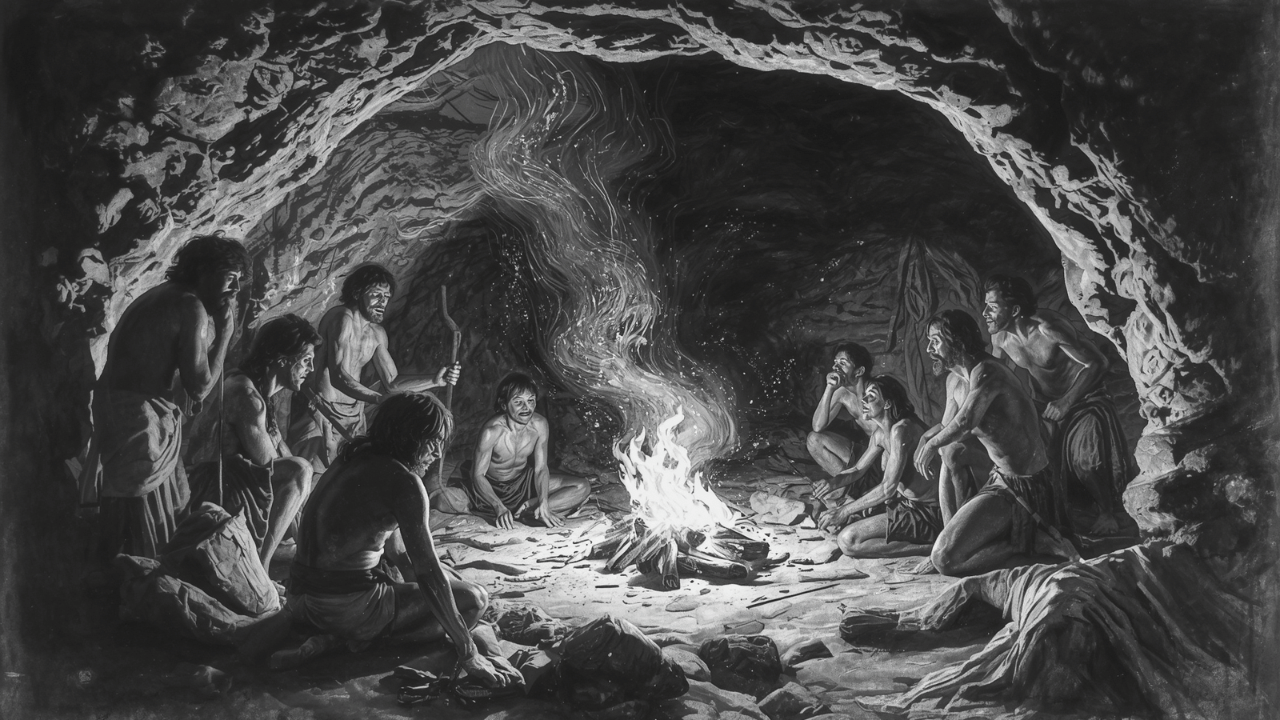
Fire gave back the night. And in that returned night — around the flame, in the warmth, in the safety that light creates in darkness — humans started doing something they had never done before at that scale.
They started talking.
Stories appeared around fires. Not because someone decided that storytelling was important. Because there was suddenly time and warmth and a circle of faces and nothing else to do. Language deepened around fires. Memory deepened around fires. The first teachers taught around fires. The first philosophers thought around fires. The first songs were probably sung around fires by people who did not think of themselves as singers — just people who were warm and safe and had a few hours they did not know what to do with.
Fire did not plan to create human culture. Fire just burned. And human nature did the rest.
That is the invisible chain. Not the warmth. Not the cooked food. The returned night and everything that grew inside it.
Every Generation Has Its Fire
This pattern — a force arrives, visible chains form, invisible chains form quietly alongside, the world reorganises itself — this is not ancient history. This is the rhythm of human progress. And it has happened close enough to your own life that you already know it.
The printing press. 1440.
Before it — a single handwritten book took two years to copy. Knowledge lived in monasteries and palaces. Behind walls. Available only to those born on the right side of those walls.
After it — a farmer’s son could read the same words as a king’s advisor. Ideas that were meant to stay inside certain rooms escaped. The Protestant Reformation happened partly because Martin Luther could print his ideas faster than the Church could stop them. The Scientific Revolution happened partly because scientists could finally read each other’s work without traveling across continents to meet.
Gutenberg did not plan the Reformation. He planned a faster way to print books. The chain went where it wanted.
The railway. India. 1853.
The engineers planned the engine, the track, the schedule. They planned everything a railway needs to run.
Nobody planned the neighbourhoods that grew around stations. Nobody planned the schools that appeared in those neighbourhoods. Nobody planned the generation of people who grew up in cities their grandparents had never seen, speaking languages their grandparents had never needed, living lives their grandparents could not have imagined.
And nobody — absolutely nobody — planned the bhajan coach.
On Mumbai local trains, in the early morning, there is a coach where people sing. Devotional songs. Every morning. The same people, the same train, the same songs, for decades. Some of them have been singing together for thirty years. They became family because the railway brought them to the same platform at the same time every morning until something beautiful emerged that no engineer ever put in the blueprints.
The railway created the proximity. The proximity created the community. The community created something that will outlast every engine on that line.
The mobile phone.
Designed for calls. That was the plan.
The vegetable vendor in your neighbourhood who now accepts Google Pay was not in that plan. The migrant worker in Mumbai who sends money to his family in Bihar in thirty seconds was not in that plan. The first generation college student who found a government scholarship at midnight in a WhatsApp group — whose life changed because of that one PDF shared by a stranger into a group of two hundred people — she was not in that plan.
One technology. One chain. Millions of lives it never intended to reach. All of them real.
The Fire That Is Burning Right Now
AI is here.
And I want to be honest with you about what that means — not in the way that technology articles are honest, listing features and capabilities and use cases — but in the way that matters for someone like you, reading this, wanting better English, wanting a more confident voice, wanting to close the gap between the English you have and the English you use.
AI is not a new app. It is not a smarter search engine. It is not a chatbot.
AI is the returned night.
It is the thing that gives back the time and the space and the patient presence that learning has always needed but never had enough of. The teacher who never gets tired. The practice partner who is available at midnight. The space where you can be wrong a hundred times without anyone remembering the ninety nine times before you got it right.
That did not exist before. Not at this scale. Not at this cost — which is free. Not with this patience. Not with this availability.
Before AI, a non-English medium student in a tier three city had this: a classroom, a textbook, occasional exposure to English films and songs, and whatever confidence they could build alone. No speaking partner. No daily practice. No immediate feedback. No way to practice the exact conversation they were afraid of — the interview, the client meeting, the college presentation — before walking into it.
That student has existed for decades. That need has existed for decades. The solution has never existed.
Until now.
AI did not arrive to solve that student’s problem. AI arrived because the largest technology companies in the world were trying to build something powerful. But the chain it pulled into existence reached that student. In her city. On her phone. For free.
The railway did not arrive to create the bhajan coach. But the bhajan coach exists because the railway arrived.
AI did not arrive to give her a voice. But she will find her voice because AI arrived.
This Is Not One Person’s Experiment
I know what you are thinking. Every few years something arrives and everyone says this is the one. This is different. This changes everything. And mostly it does not. Mostly it is noise.
So let me tell you what is actually happening — not hype, not fear, just facts.
The Indian government launched the National AI Mission with ten thousand crore rupees. Not a pilot. A mission. For AI in agriculture, healthcare, education, infrastructure. This is a government deciding that AI is as foundational as electricity.
Google — the company that runs the search engine you use, the maps you navigate with, the YouTube you watch — has rebuilt its entire future around AI. Not as an add-on. As the centre of everything.
UNESCO has published guidelines for every country in the world on how to use AI in education. Not whether. How.
The European Union has passed laws to govern AI — because something powerful enough to need laws is something real enough to take seriously.
This is not one person’s app. This is the world — governments, universities, international bodies, the largest companies ever built — collectively deciding that this technology is as important as fire was to the first humans who stopped running from it.
You do not have to love it. You do not have to trust it completely. There are real risks and the people raising them are not wrong. Every fire burns. The question has never been whether fire is dangerous.
The question has always been — who learns to use it.
Why This One Is Different From Every Trend You Ignored
You have been right to be skeptical before. Blogging was going to change everything — for most people it did not. Cryptocurrency was the future — for most people it was noise. Dozens of apps were going to revolutionise learning — most of them disappeared quietly.
Your skepticism has served you well. Keep it.
But here is the difference — and I want to say this carefully.
Every technology you ignored was a tool for one specific thing. Blogging was for publishing. Cryptocurrency was for transactions. Step-counting apps were for steps.
AI is not a tool for one specific thing. AI is a tool for thinking. For language. For learning. For communicating. For understanding anything you want to understand. It is not one application. It is a layer underneath every application. The way electricity is not one machine — it is what every machine runs on.
That is the difference. Not the popularity. Not the funding. The depth.
Fire did not just solve the problem of being cold. It went underneath everything — food, safety, language, culture, the length of the human day. AI is going underneath everything in the same way. Slowly at first. Then in ways nobody planned. Then in ways nobody can stop.
The question is not whether this is real. The question is what you are going to do while it is forming.
The Person Who Stopped Running
Four hundred thousand years ago someone stopped running from fire.
We do not know their name. We do not know if they were afraid. We do not know if the people around them thought they were being reckless or brave or simply strange.
We know only the result. Which is everything. Which is us.
You have a phone. You have curiosity. You have a language you want to speak with more confidence and a vocabulary you want to grow and a voice that is present but not yet fully free.
You do not have to be fearless. You do not have to understand everything about how it works. You do not have to be the most enthusiastic person in the room.
You just have to stop running.
Move a little closer. Ask one question. See what the fire gives back.
The chain is already forming.
You get to be part of it.