You Already Know More English Words Than You Think — AI Will Prove It
The gap between the English you understand and the English you speak is bigger than you imagine. And closing it is simpler than you think.
Let me describe someone you probably know.
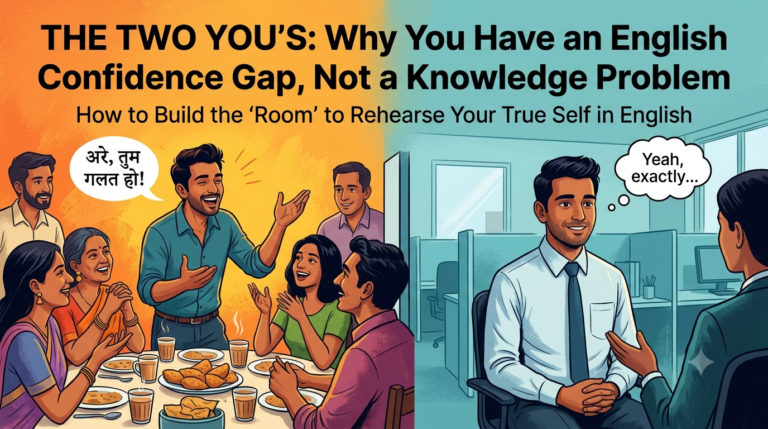
She watches anime. Naruto. Attack on Titan. Death Note. In English — original audio, English subtitles, or no subtitles at all by season two. She understands everything. The humor. The heartbreak. The sarcasm. The exact moment a character’s voice breaks and what that means emotionally. She does not pause. She does not rewind to check a word. She just watches and understands — the way you understand something you have always known.
She also gets English memes before the text fully loads. She understands the joke, the reference, the layer underneath the layer. She reads English tweets, English Reddit threads, English WhatsApp forwards — and processes them in real time without translating in her head first.
Her English comprehension is genuinely strong. Not basic. Not developing. Strong.
Now ask her to describe the last episode she watched.
“It was very good. Very emotional. The main character did something very brave. It was just… nice. I liked it a lot.”
The same person who understood every nuance of a twenty minute emotionally complex anime scene in English — cannot find the word devastating when that is exactly what the episode was. Cannot say relentless when describing the character’s determination. Cannot reach bittersweet even though she felt it completely when the episode ended.
The words are inside her. They have been inside her for years. She has heard them. Read them. Understood them. They just have never come out of her mouth.
That gap — between the English you understand and the English you speak — has a name. And once you know it exists, everything about your English journey changes.
Passive Vocabulary and Active Vocabulary
Every person who knows a language has two vocabularies.
The first is your passive vocabulary. Words you understand when you hear them or read them. No effort. No translation. Just instant recognition. Devastating. Resilient. Nostalgic. Relentless. Bittersweet. You have seen these words. You know what they mean. They do not confuse you.
The second is your active vocabulary. Words you actually produce when you speak or write. Words that come out in real time under real pressure in a real room.
For most non-English medium Indians who have spent years consuming English content — series, films, music, memes, books, social media — the passive vocabulary is enormous. Genuinely enormous. Thousands of words sitting quietly inside, fully understood, waiting.
The active vocabulary is a fraction of that. Sometimes one third. Sometimes less.
That fraction is the gap.
And the gap is not about intelligence. Not about how much you studied. Not about how much English you consumed. It is about one thing only — practice converting passive words into active ones.
That practice, before AI, was very difficult to get every day. You needed a patient partner. A space where being wrong had no consequences. A place where you could try a word, fail, try again, fail better, and eventually own it.
Now that place is in your pocket. Free. Always open.
How AI Makes The Gap Visible
Before you can close a gap you have to see it. Most people cannot see their own vocabulary gap because they are inside it. They know what they mean to say — they just do not know which words they are not using.
AI shows you.
Open any AI app. ChatGPT, Claude, Gemini, Grok — any one. Type this:
“I am going to describe something to you — a series I am watching, a film I liked, or something that happened to me recently. After I describe it, tell me three to five words I was probably reaching for but did not use. Words that would have made my description more precise. Words that were likely in my passive vocabulary but did not come out. Do not give me difficult words — give me words that someone who watches English series would probably already understand.”
Now describe something. Your favourite series. A scene that moved you. Your commute this morning. A conversation you had. Describe it the way you naturally would — in your real everyday English. Do not try to sound impressive. Just talk.
Read what AI gives back.
Those three to five words — that is your gap made visible. And the moment you read them you will feel something specific. Not confusion. Recognition. Yes. That is exactly the word I meant. That feeling is important. It is proof that the word was already inside you. It just needed a door.
Five Practical Ways to Get Vocabulary Feedback From AI
Feedback Method 1 — The Description Mirror
Describe anything. A place. A person. A feeling. A scene from something you watched. Describe it fully — two to three sentences minimum.
Then type:
“What words did I avoid that would have made this description more vivid and specific? Show me the word, its simple meaning, and how I could have used it in my description.”
AI shows you the mirror. You see what was missing. You rewrite the description using the suggested words. You compare both versions. The difference between the two versions — that distance is the gap. And you just crossed it once.
Do this every day for one week with different descriptions. Seven crossings. The gap gets smaller each time.
Feedback Method 2 — The Repeat and Upgrade
Tell AI a story. Something real — something that happened to you this week. Tell it naturally, the way you would tell a friend. Two to three minutes of talking, typed out.
Then type:
“I just told you a story. Now retell the same story back to me — but use more precise and vivid vocabulary where I used basic words. Keep the meaning exactly the same. Keep my voice. Just upgrade the words.”
Read AI’s version of your own story. Your story. Your experience. Your feelings — but with the words that fit them properly.
This is not AI replacing your voice. This is AI showing you what your voice sounds like when the vocabulary catches up with the feeling. Read it slowly. Notice which upgrades feel right and which feel too formal for you. Keep the ones that feel right. That is how you build your active vocabulary — by trying words on until some of them fit.
Feedback Method 3 — The Pattern Finder
After three or four conversations with AI — or after practicing with AI for a week — type this:
“Looking at the way I have been writing and speaking in our conversations — what vocabulary patterns do you notice? What words do I overuse? What kinds of words am I consistently avoiding? What is one specific thing I could work on this week?”
This is not correction of one sentence. This is a pattern diagnosis. AI looks across everything you have said and finds the habit — the word you reach for automatically, the vocabulary level you are comfortable in, the words you consistently avoid even when they would fit perfectly.
One pattern identified. One thing to work on this week. Not ten things. One.
One thing practiced seriously for one week changes a habit. Ten things noticed and forgotten change nothing.
Feedback Method 4 — The Emotion Vocabulary Check
This one is specifically for the person who understands emotional English content but cannot produce emotional English vocabulary.
Think of a moment that had strong feeling — something that made you happy, nervous, proud, disappointed, surprised. Write three sentences describing how you felt.
Then type:
“I just described an emotional experience. What emotion words was I reaching for but not finding? Give me five words that describe emotions more precisely than the basic words I used. Simple meanings. One example sentence each.”
Emotional vocabulary is the most personal vocabulary. The words for what you feel are the words people remember most about you when you speak. Overwhelmed. Conflicted. Elated. Apprehensive. Moved. These words exist in your passive vocabulary — you have felt them in films and series and songs. AI helps you move them to the side of the gap where you can actually use them.
Feedback Method 5 — The Before and After
This is the feedback method that shows you progress over time — and progress is the thing that keeps you going when motivation dips.
Save one paragraph you wrote or typed today. Any paragraph. A description, a story, an opinion — anything.
Come back to it in two weeks. Type it into AI and say:
“This is something I wrote two weeks ago. I have been practicing vocabulary with AI since then. Can you upgrade this paragraph now — and also tell me if you think my vocabulary has improved based on our recent conversations?”
Read the upgraded version. Compare it to where you were two weeks ago. The distance between those two versions — that is not a gap anymore. That is growth. Visible, specific, personal growth.
That moment — seeing your own before and after — is worth more than any vocabulary score or level test. Because it is yours. You made it happen. And you can see exactly how.
The Words Were Never Missing
I want to end with something honest.
The vocabulary you are trying to build is not new vocabulary. It is not foreign vocabulary. It is not difficult vocabulary.
It is your vocabulary. Already inside you. Already understood. Already felt — in every series you watched, every song you heard, every meme you laughed at, every English conversation you followed without effort.
The gap was never about knowing. It was always about using.
AI is the practice space that finally makes daily using possible. Not once a week in a class. Not when you find a patient partner. Every day. In your own time. About your own life. With your own words getting stronger each time.
The room was never locked.
You just needed someone to show you the door was already open.