Why You Go Blank in English (And How AI Fixes It)
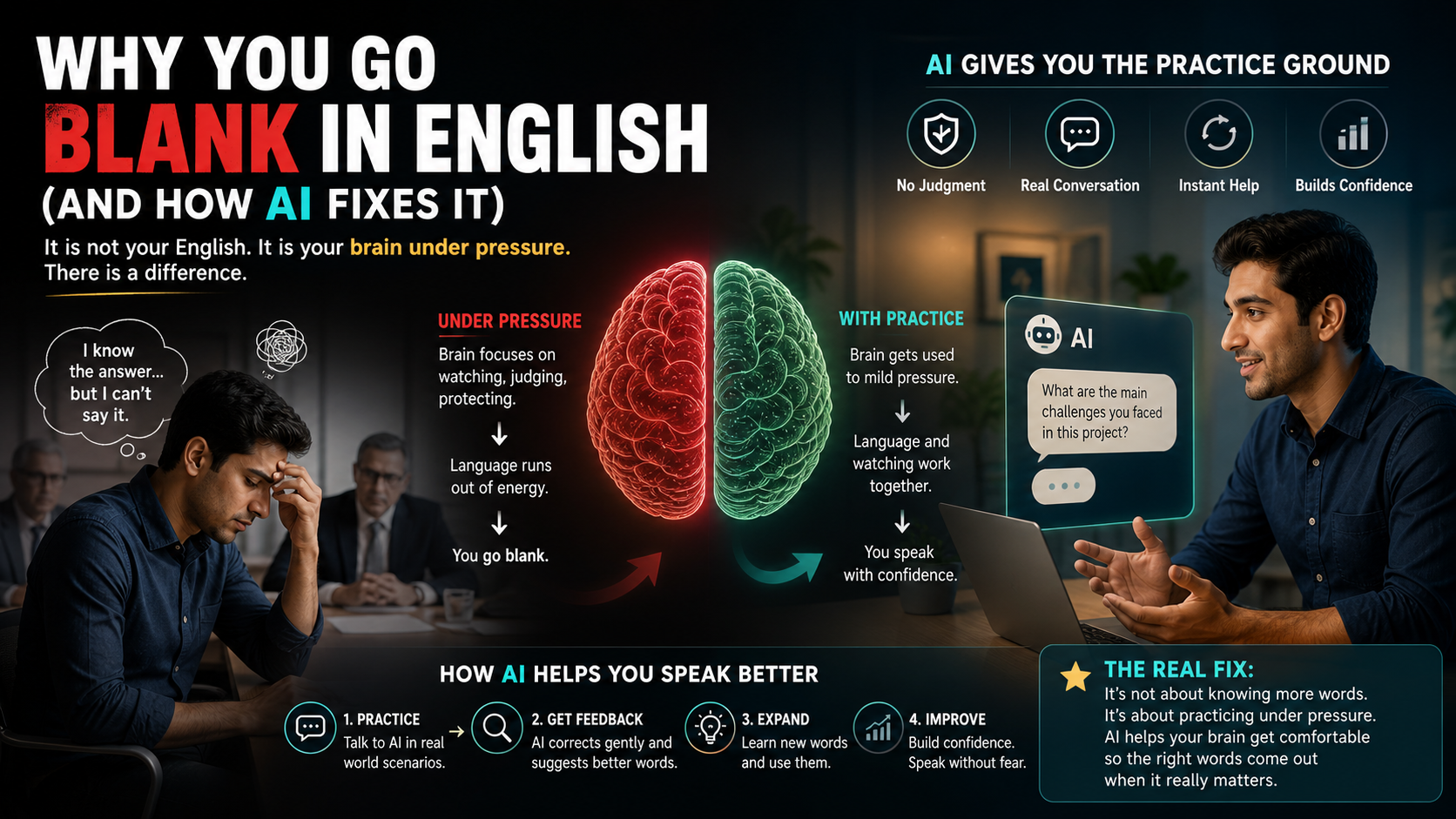
It is not your English. It is your brain under pressure. There is a difference.
Let me describe a moment you already know.
You are in a room. Someone asks you something in English. You know the answer. You have known the answer for years. But the moment you open your mouth — nothing comes. The word is somewhere inside you. You can almost feel it. But it will not come out. Your mouth opens. A small sound. Then silence.
And in that silence, something worse happens. You think: I knew this word. Why can I not say it? What is wrong with me?
Nothing is wrong with you.
Your brain just did exactly what a brain does under pressure. It froze.
The Teacher and The Principal
I have coached school teachers. Many of them. Privately and in groups.
Every single one of them told me the same thing. In front of their students they are fine. Comfortable. They speak, explain, joke, correct — without thinking about their English at all. The words just come.
But the moment they sit in a meeting with their principal or trustee — the same teachers go blank. Mid-sentence. They forget words they use every day. They speak faster than normal, then slower, then stop completely. They come out of that meeting feeling embarrassed. Feeling like their English failed them.
Their English did not fail them. The room changed. And when the room changed, their brain changed.
I have also worked with business owners. People who run their own companies. With their team they are relaxed — the team is like family, they are used to each other, nobody is judging anyone’s English anymore. But when a new foreign client walks in — the same person who just gave a confident briefing to his team goes quiet. Makes mistakes he would never normally make. Loses words he uses every day.
Same person. Same English. Different room.
This is the whole story. And once you understand it, the blank is never as frightening again.
What Is Actually Happening in Your Brain
Your brain has two jobs it is trying to do at the same time when you speak in a second language.
The first job is language. Finding the word, building the sentence, making it make sense.
The second job is watching. Watching the room. Watching the faces. Watching for signs that you are being judged, that you made a mistake, that someone noticed something wrong.
When the room feels safe — a junior, a student, a friend, someone who will not judge — the brain gives most of its energy to the first job. Language flows.
When the room feels dangerous — a senior, a foreign client, a principal, someone whose opinion matters — the brain gives most of its energy to the second job. Watching. Protecting. And the first job — the language — runs out of energy.
The word does not disappear. It is still there. But the door to it is temporarily locked. By fear. By pressure. By the part of your brain that is trying to protect you from embarrassment and accidentally making the embarrassment worse.
This is not a language problem. This is a survival mechanism in the wrong situation.
Why Practice Alone Is Not Enough
Here is something most English courses never tell you.
You can practice English alone for years. Read every day. Watch English films. Do grammar exercises. Build vocabulary. And still go blank in a room that matters.
Because alone, there is no pressure. Alone, the second job — the watching, the protecting — has nothing to watch. So the language flows easily. You feel fluent. You feel ready.
Then the room happens. The pressure arrives. And the brain, which has never practiced working under pressure, does not know how to handle both jobs at the same time.
This is why people say — at home my English is fine. In the office I forget everything. They are not lying. They are not being dramatic. They are describing something completely real.
The solution is not more vocabulary. The solution is not more grammar. The solution is pressure practice. Practicing in conditions that feel slightly uncomfortable — so that the brain slowly learns to do both jobs at the same time. Language and watching. Speaking and being seen.
Before AI, this was very difficult to arrange. You needed a partner. A class. A group. Someone to practice with who could create that slight pressure without real consequences.
Now you have AI.
How AI Fixes This — Step by Step
AI is not a human. It does not judge you. It does not remember your mistakes from yesterday. It does not make a face when you use the wrong word.
But here is the thing — it is still a conversation. And conversation, even with a machine, activates the same brain processes as a real conversation. Your brain is still searching for words. Still building sentences in real time. Still doing the first job under mild pressure.
And mild pressure practiced every day builds the muscle.
Start here.
Open any AI app — ChatGPT, Claude, Gemini, Grok, whichever you have. Type this:
“I want to practice speaking English under mild pressure. Pretend you are my senior colleague or manager. Ask me questions about my work or a recent project. If I go blank or use very basic words, encourage me gently and help me find better words. Do not let me give one word answers.”
Now answer. Out loud if you can — speak and type what you said. If not, type your answers as if you are speaking them.
The AI will push back gently. Ask follow up questions. Not let you escape with “it was good.” This is the pressure practice your brain needs. Safe pressure. Consequence-free pressure. But pressure.
Then try this.
“Pretend you are a foreign client I am meeting for the first time. Ask me about my company and what we do. I will try to explain it confidently. If I use filler words like ‘basically’ or ‘you know’ too much, point it out.”
This is the exact situation that freezes people. Practiced safely. As many times as you need.
And this — for the word retrieval problem specifically.
When you go blank on a specific word — when you can feel the word but cannot find it — type this in AI:
“I am trying to say that something was very efficient and saved a lot of time. What is a good word for that? Give me three options with simple meanings.”
The AI gives you streamlined. Effective. Time-saving. You pick one. You use it in your next sentence. The blank is filled. And next time that word is a little more available because you used it once already.
The Real Fix
The blank is not a vocabulary problem. It is a pressure problem.
The word is inside you. It has always been inside you. What blocks it is the part of your brain that decides — in that exact moment — that the room is too dangerous to risk the wrong word.
The fix is to make the brain practiced enough that it stops seeing every English conversation as dangerous.
AI gives you the practice ground. A room with no consequences. No judgment. No memory of your worst sentences. Just conversation, every day, building the muscle that the real room will one day demand.
The teacher who goes blank in front of the principal — she does not need better English. She needs more practice in rooms that feel like the principal’s room. Safe versions of that room. AI is that room.
The business owner who loses words in front of the foreign client — he does not need a new vocabulary. He needs his brain to have been in that conversation enough times that it stops treating it as an emergency.
Practice the pressure. Every day. Ten minutes.
The blank gets smaller. The words come faster. The room stops feeling dangerous.
Not because your English changed. Because you did.