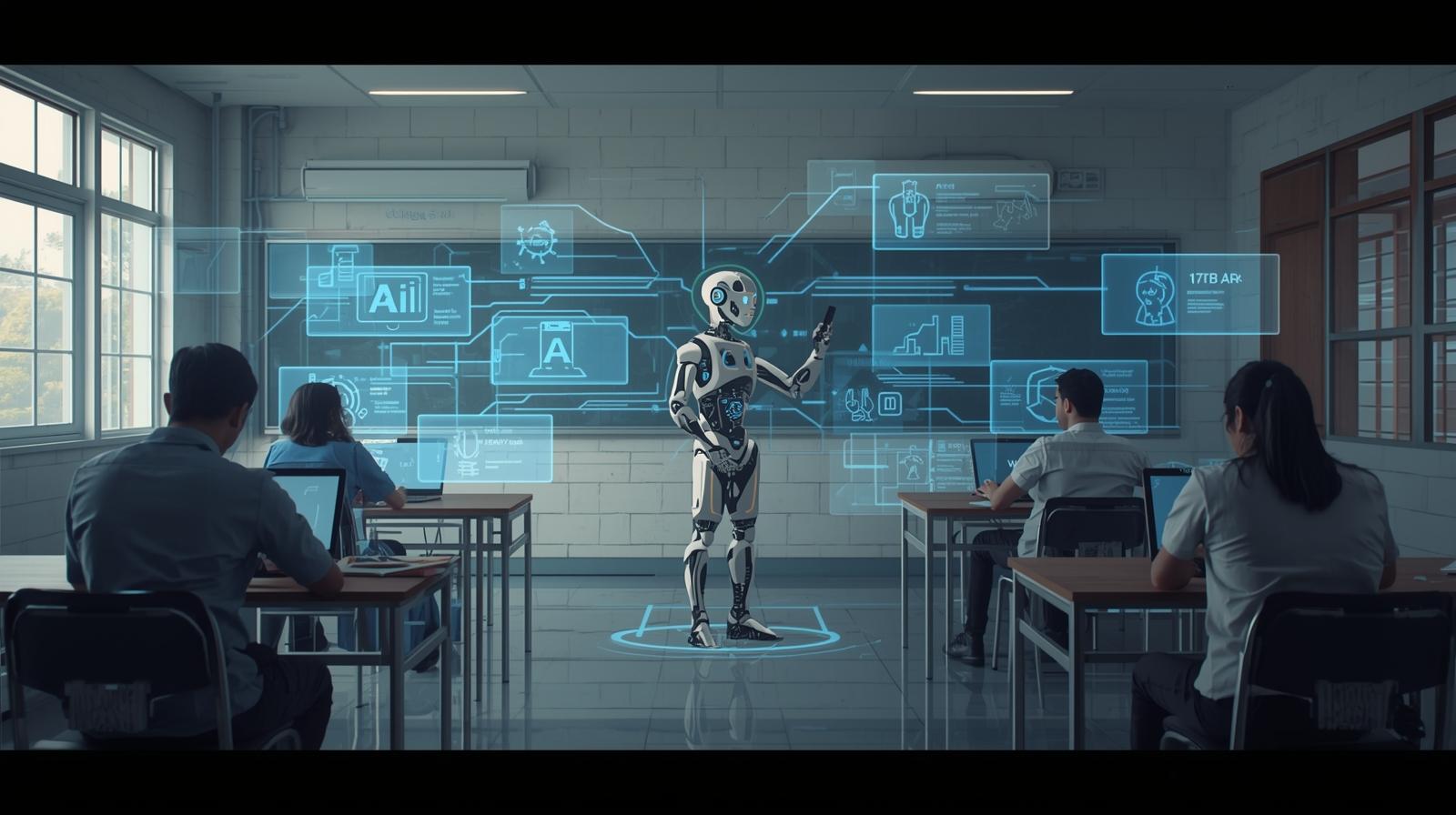
The Future of AI and Education in India (2026–2036)
In 2026, India is not asking whether AI will enter education.
It already has.
After events like the India AI Summit 2026, policy announcements, startup showcases, and AI-powered classrooms being demonstrated across metros, one thing is clear:
The infrastructure conversation has begun.
But here’s the uncomfortable truth:
We’ve had infrastructure before.
We’ve had smart boards.
We’ve had computer labs.
We’ve had English textbooks.
And yet—
We still don’t teach public speaking as a core subject.
We don’t teach content creation as a skill.
We don’t teach persuasion, storytelling, or digital confidence.
We don’t teach how to run Instagram ads, pitch ideas, or speak on camera.
We teach information.
The world rewards expression.
So the real question for 2026–2036 is not:
“Will India adopt AI in education?”
The real question is:
“Will India finally teach students how to express themselves in a world where expression creates income, influence, and independence?”
The Next 10 Years: What Will Actually Happen
Let’s be realistic. Not cinematic. Not science fiction.
Here’s what AI in Indian education will probably look like between 2026 and 2036.
1. AI Will Become a Daily Companion — Not a Computer Lab Tool
AI will not live in a separate room called “AI Lab.”
It will live in:
- Every student’s phone
- Every college Wi-Fi network
- Every entry-level job workflow
- Every interview preparation process
Students won’t “go to learn AI.”
They’ll just use it the way they use Google today.
The difference?
Google gives information.
AI gives interaction.
And interaction changes education.
2. Practice Will Finally Scale (If We Let It)
For decades, Indian education has had one fatal flaw:
We teach. We don’t practise.
You cannot build:
- Speaking confidence
- Fluency
- Leadership presence
- Debate skill
- Interview readiness
…by listening.
You build it by doing.
AI makes practice scalable for the first time in history.
One teacher cannot give 200 students daily speaking practice.
One AI system can.
This is where the shift becomes powerful:
Not AI as teacher.
AI as practice amplifier.
3. Degrees Will Matter Less. Demonstration Will Matter More.
Between 2026 and 2036, hiring in India will quietly change.
Not overnight.
But steadily.
Recruiters will increasingly ask:
- Show me your work.
- Show me your communication.
- Show me how you think.
- Show me your video.
- Show me your project.
The student who can:
- Speak clearly for 5 minutes
- Explain a concept simply
- Record a confident video
- Pitch an idea
- Use AI effectively
…will outperform someone with a higher percentage but lower expression skill.
This shift has already started in startups, creator economy, and remote work roles.
It will slowly enter mainstream hiring.
4. AI Will Expose the “Silent Graduate” Crisis
India produces millions of graduates every year.
But how many can:
- Speak confidently in English?
- Present ideas clearly?
- Think aloud in structured sentences?
- Ask intelligent questions?
AI will expose this gap brutally.
Because when every student has access to the same AI tools, the difference won’t be information anymore.
The difference will be:
- Confidence
- Fluency
- Independent thinking
And those cannot be downloaded.
They must be practised.
5. Schools Will Resist. Colleges Will Experiment. Individuals Will Lead.
This is my honest prediction.
- Government schools will adopt AI slowly.
- Private schools will use AI as a marketing feature.
- Colleges will experiment through labs and workshops.
- Coaching institutes will integrate AI fastest.
- But individuals — ambitious students — will move the fastest.
Because motivated students don’t wait for curriculum approval.
They adapt.
The next 10 years will not be led by institutions alone.
They will be led by self-driven learners who use AI daily.
6. Real Paid Skills Will Finally Enter the Conversation
We still don’t formally teach:
- Public speaking
- Video editing
- Content writing for digital platforms
- Running Instagram/Meta ads
- Personal branding
- Persuasive communication
Yet these are real paid skills in 2026.
AI will force curriculum committees to ask uncomfortable questions:
Why are we teaching outdated theory but not practical digital expression?
If India is serious about becoming an AI superpower, education must shift from:
“Memorise and reproduce”
to
“Create and communicate.”
7. English Will Stop Being the Hero. Expression Will Become the Hero.
This is important.
The future is not about English grammar perfection.
It’s about:
- Clarity
- Confidence
- Structured thinking
- Independent articulation
AI can help students practise in English.
But the real goal is not English.
The real goal is independence.
A student who can:
- Think clearly
- Speak clearly
- Learn independently using AI
…becomes unstoppable in any language.
What I Hope Happens (2026–2036)
Here’s my grounded hope — not fantasy.
- Every college in India has an AI Practice Lab.
- Speaking practice becomes weekly, not annual.
- Students are graded on presentation ability.
- AI usage becomes a normal study habit.
- Communication confidence becomes a measurable outcome.
- Self-learning using AI becomes a taught skill.
- Degrees become supported by demonstrable skills.
Not dramatic transformation.
But steady evolution.
The Risk: We Add AI — But Change Nothing
The biggest danger is this:
We add AI to the classroom.
But we keep the same mindset.
If AI becomes just:
- A homework solver
- A note generator
- A shortcut tool
Then we will produce faster students.
Not stronger thinkers.
AI should not replace struggle.
It should structure practice.
The Real Future of AI and Education in India
Between 2026 and 2036, India has a choice:
Use AI to automate learning.
Or
Use AI to amplify human expression.
If we choose the second path, we will create:
- Confident speakers
- Independent learners
- Creative professionals
- AI-literate citizens
If we choose the first, we will create:
- Faster memorisers
- Better copy-pasters
- Highly dependent graduates
The difference will not be technology.
It will be philosophy.
Final Thought
India doesn’t lack intelligence.
It lacks structured practice systems.
AI gives us the first real opportunity to scale practice — especially in communication, confidence, and independent thinking.
The next 10 years will not be about who has access to AI.
They will be about who knows how to use AI to practise, think, speak, and build real skills.
And that is where the future of Indian education will quietly be decided.